





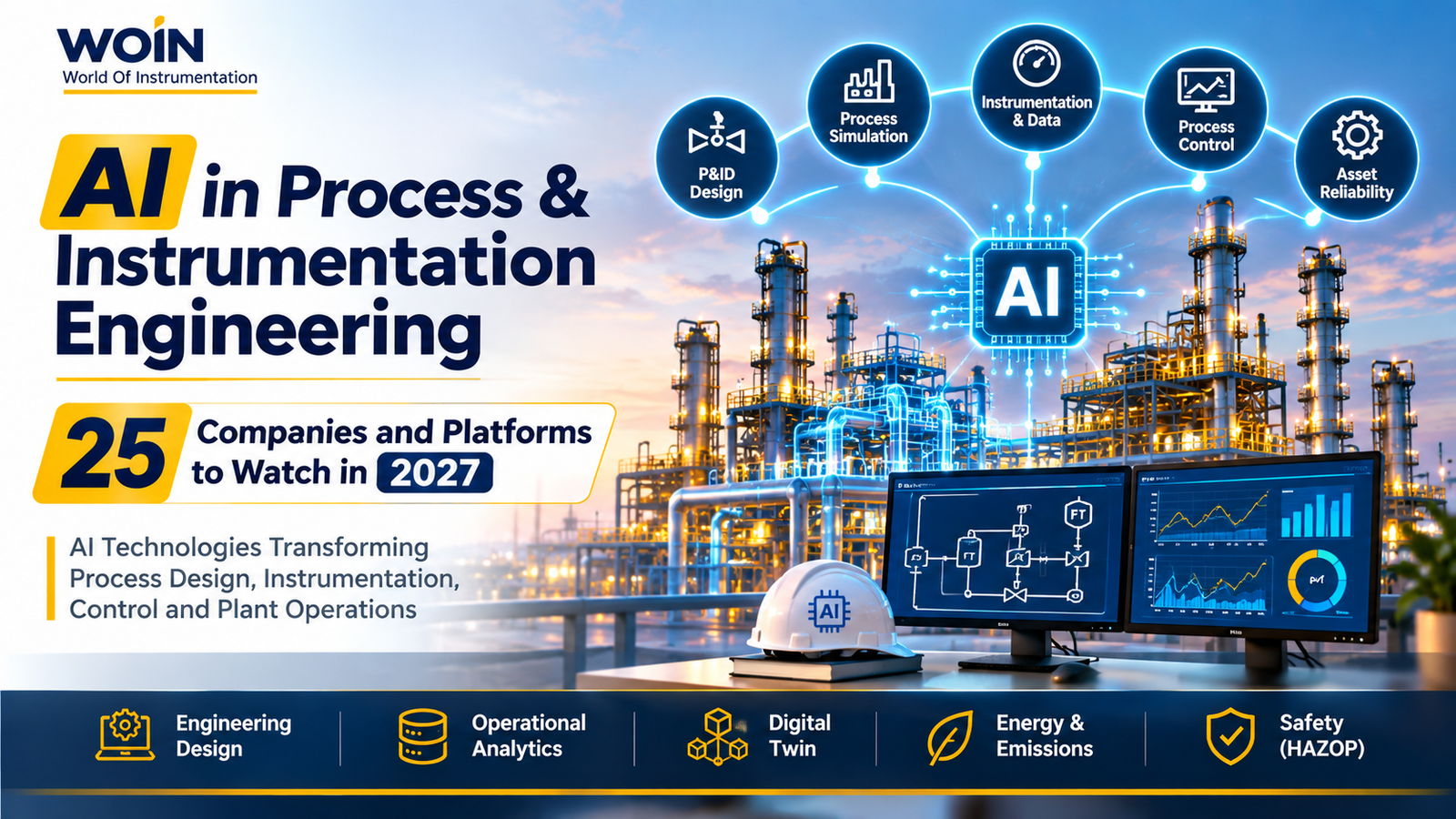
WOIN ENGINEERING TECHNOLOGY · 2027 OUTLOOK
A global directory of websites and platforms applying AI to process design, P&IDs, instrumentation deliverables, process simulation, automation engineering and plant operations.
Research update: 14 November 2026 · Includes commercial platforms, early-access products and open research projects.
Artificial intelligence is moving into the engineering work that creates, checks and maintains process plants. The most important development is not another general-purpose chatbot. It is the arrival of domain-specific systems that can interpret a P&ID, understand relationships between instruments and equipment, prepare engineering deliverables, interact with simulation tools, help configure automation systems and analyse live process data.
This WOIN guide maps the companies, research groups and product websites building those capabilities. It is organised by organisation or website, with a short explanation of its engineering focus and the product or project name to investigate. It is not a ranking and does not imply that every platform is open-source or ready for safety-critical deployment.
The directory focuses on AI that touches core process or instrumentation work: PFD/P&ID understanding, engineering data extraction, instrument index and datasheet workflows, I/O list generation, process modelling, control configuration, process optimisation, measurement support and operational diagnostics. General office chatbots, generic image generators and unrelated factory-vision products are excluded.
AT A GLANCE The engineering lifecycle AI is starting to touch
and simulation
intelligence
and datasheets
engineering
and diagnosis
and reliability
P&IDs are becoming structured, queryable engineering data rather than static drawings.
AI is beginning to prepare and reconcile instrument indexes, line lists, I/O lists and datasheets.
Process simulation and physics-based models are being connected to AI agents and optimisation loops.
Industrial AI is moving closer to control rooms, maintenance teams and field instrumentation support.
01 Engineering design, P&IDs and project deliverables
Websites Applying AI to Process and Instrumentation Engineering Design
This is the most directly relevant category for EPC and brownfield engineering teams. The platforms below focus on interpreting drawings, creating structured engineering information, keeping project documents aligned and reducing repetitive drafting or data-entry work.
PI Research — TU Delft
The Process Intelligence Research group at TU Delft is an important academic source for AI-native process engineering. Its research turns P&IDs and process flowsheets into machine-readable structures that engineering software and AI systems can use. The group’s projects have different release states and licences; they should not be treated as one uniformly open-source product.
- DigiCo digitises legacy P&IDs/PFDs into Smart P&ID data.
- ChatP&ID uses GraphRAG to answer questions grounded in P&ID topology.
- ChemE-as-Code connects agent workflows to process simulation, layout, HAZOP and engineering files.
- pyDEXPI and DEXPI Studio make DEXPI-based P&ID data usable and inspectable.
- ChatP&ID is a research demonstrator; it is not the same as a fully supported commercial P&ID platform.
AVEVA
AVEVA is embedding AI directly into multidisciplinary engineering and design workflows for EPCs and asset owners. The emphasis is on helping engineers interrogate project context, explore layout alternatives and train predictive models around design decisions.
- Natural-language assistance for project engineering knowledge.
- AI-generated layout options, including pipe-routing alternatives.
- No-code predictive models using customer data.
- AI-assisted classification of point-cloud data alongside 1D/2D/3D design information.
Siemens
Siemens is applying generative and agentic AI to industrial automation engineering. The latest engineering-focused development connects AI to the actual automation project instead of treating PLC programming as a generic code-generation task.
- Uses the active TIA Portal project as context instead of generating generic automation code.
- Can work with PLC code, function blocks, user-defined data types and related project elements.
- Understands relationships between PLCs, HMI screens and drives in the project.
- Uses multi-step reasoning and self-correction; outputs can be checked against customer project standards.
Intelligent Project Solutions (IPS)
IPS focuses on digitising and re-engineering engineering drawings and documents. Its products are relevant to projects where legacy PDFs, scanned drawings and document registers must be converted into structured digital engineering information.
- Recognises P&IDs, PFDs, plant layouts, equipment, electrical and instrumentation drawings.
- Supports search, comparison and modification of extracted drawing information.
- Can recreate intelligent drawing formats and produce engineering deliverables such as instrument, valve, line and equipment lists.
- iDocuments targets document digitisation and datasheet workflows.
SymphonyAI Industrial
SymphonyAI is building an industrial AI data foundation where engineering drawings, plant assets, process data and operational agents share a common context. P&ID digitisation is positioned as a way to create the structured plant model needed by downstream AI applications.
- Vision AI extracts equipment, tags, valves, instruments and connectors from P&IDs.
- Extracted objects are mapped into an asset hierarchy with engineer verification.
- Pre-built agents target alarm response, RCA, predictive maintenance and process optimisation.
Verno
Verno presents an AI engineering-document platform for EPC and owner-operator teams; its website invites engineers to request a demonstration on their own drawings. Its distinctive focus is not only reading a drawing, but drafting proposed changes into native CAD files and carrying accepted changes through related project documents.
- Reads and proposes changes to native DWG/DXF P&IDs.
- Checks drawing information against line lists, valve lists, instrument indexes and tie-in schedules.
- Can build or update instrument indexes, I/O lists and datasheets in project templates.
- Describes revision history, audit trails and engineer acceptance before changes are written.
DeepIQ
DeepIQ applies AI to engineering drawing extraction and industrial data contextualisation. Its P&ID digitisation work targets the conversion of drawing information into structured data that can be connected with plant systems and operational knowledge.
- Extracts equipment specifications, process parameters and interconnected systems from P&IDs.
- Supports conversion of unstructured drawing information into organised engineering data.
- The provider also describes knowledge-graph approaches for connecting P&IDs, process-historian data and enterprise systems; validate the currently supported integrations with the vendor.
QONG Systems
QONG is developing an AI-powered engineering platform aimed at oil and gas FEED and EPC workflows. It focuses on reading P&IDs and using the resulting engineering dataset to create linked discipline deliverables.
- Extracts symbols, annotations, tag numbers and component relationships from P&IDs.
- Targets instrument indexes, instrument datasheets, I/O lists, valve lists, line lists and equipment lists.
- QONG BOX is described as an on-premises/offline deployment option for data-sovereignty requirements.
VARENX
VARENX describes itself as a domain-specific AI initiative for process and manufacturing. Publicly accessible technical material reviewed for this article did not provide enough detail to independently verify its exact engineering functions, supported file formats, benchmark performance or release status.
- Monitor the provider for technical documentation, demonstration access and named customer references.
- Request evidence of P&ID recognition accuracy, topology handling and revision traceability before considering a pilot.
- Do not assume that website positioning establishes production readiness or independently benchmarked performance.
AISYNOVA TechLabs
AISYNOVA presents an AI suite tailored to EPC engineering tasks rather than general document chat. The published module map spans drawing intelligence, discipline deliverables, document knowledge and engineering analytics.
- Describes symbol detection, line tracing and tag normalisation for non-intelligent P&IDs.
- Targets instrument-index and instrument-datasheet extraction.
- Includes equipment, load-list, MTO and mechanical-datasheet modules, some shown as beta.
MetaPlant AI
MetaPlant AI describes an end-to-end process engineering environment that links process diagrams, simulation, equipment sizing and documentation through a connected project model.
- Generates draft PFDs from text or voice input.
- Claims a linked PFD-to-P&ID-to-simulation workflow with heat and material balances.
- Targets equipment sizing, lists, datasheets and reports from a shared data model.
- The website is seeking pilot partners to test the workflow on real projects.
Dualizer
Dualizer presents a physics-grounded AI approach to process engineering. Rather than relying on a language model to invent engineering calculations, its KinetIQ platform describes a reviewable process model that is solved by a deterministic simulation engine. The provider says its public demonstration histories contain 48 synthetic operating points with planted faults and that no result has yet been validated on measured plant data.
- Reads process drawings and operating data into a structured process model.
- Uses an AI copilot to propose explicit, reviewable model changes.
- Its published demonstration shows flowsheet modelling and equation tracking; treat wider 3D/layout claims as provider-described capabilities requiring a live demonstration.
Telero
Telero is a paid SaaS product positioned as an AI assistant for process engineers that converts process intent and source files into a preliminary process design package. It explicitly states that rigorous simulation tools remain in the workflow rather than claiming to replace them.
- Targets process flow diagrams, heat and material balances, equipment lists and specification sheets.
- Can use existing simulation files, spreadsheets, client specifications and standards as reference inputs.
- Its FAQ states P&ID generation is not yet available.
KukuTech — ProcAgent
ProcAgent is a process-simulation assistant that aims to handle repetitive setup work while leaving thermodynamic calculations to established simulation engines. The site describes compatibility with Aspen HYSYS and ProMax.
- Uses a PFD and natural-language instructions to help create a simulation model.
- Targets fluid-package setup, stream definition, equipment setup and convergence troubleshooting.
- Connects to real simulation engines instead of relying only on language-model-generated calculations.
02 Process operations, control and industrial AI
Websites Applying AI to Process Control and Plant Operations
These organisations focus on the operating plant: process data, process constraints, operator knowledge, asset behaviour and control-system performance. Their AI may recommend actions, support diagnosis or optimise a process. That does not automatically mean the software is authorised to write directly to a DCS or safety system.
Emerson / AspenTech
Emerson introduced AspenTech AVA in May 2026 as an agentic, domain-aware AI platform for industrial companies. AspenTech also offers separate process-modelling, asset-performance and advanced-control products; the names below should not be read as interchangeable modules of AVA.
- AVA provides an agentic, domain-aware AI layer for industrial operations.
- Aspen Hybrid Models combine first-principles models and data-driven modelling in supported applications.
- Aspen Mtell focuses on asset performance and early detection of equipment failure modes.
- Aspen DMC3 Virtual Advisor supports advanced process-control performance understanding; it is a distinct product capability.
Honeywell
Honeywell is extending AI into control-room workflows and production intelligence. The objective is to capture operating expertise, identify abnormal situations and assist operators with context-aware guidance.
- Experion Cognition is described as an AI digital companion integrated with Experion control systems.
- It captures expertise, detects emerging situations and guides operator decisions.
ABB
ABB’s Genix platform connects OT, IT and engineering data with analytics and AI applications. It is particularly relevant to instrumentation teams because ABB has also described a measurement-focused copilot for support during commissioning and troubleshooting.
- Natural-language interaction with contextualised plant and asset information.
- APM Copilot summarises asset events and supports predictive diagnostics.
- My Measurement Assistant+ is a separate ABB self-support service for product knowledge, tailored guidance and measurement-device troubleshooting; it should not be labelled as a Genix product.
Yokogawa
Yokogawa has worked on reinforcement-learning control and broader industrial AI use cases including design optimisation, operation optimisation, troubleshooting and quality stabilisation. Its work links AI to industrial controllers and real plant operations.
- The Autonomous Control AI Service packages reinforcement-learning software for OpreX Realtime OS-based e-RT3 Plus edge controllers.
- FKDPP is the reinforcement-learning algorithm used by the service.
- Yokogawa has reported field work on autonomous control in chemical-plant applications; distinguish the packaged edge-controller service from separate customer trials.
Schneider Electric
Schneider Electric has announced two distinct industrial-AI collaborations in 2026. Its April collaboration with Microsoft and Azure AI focuses on agentic manufacturing and lifecycle engineering around EcoStruxure Automation Expert. Its October collaboration with NVIDIA and HPE focuses on Physical AI and edge-deployed Industrial AI Agents for process and heavy industries.
- The Microsoft collaboration announced agentic-manufacturing capabilities and an Industrial Copilot powered by Azure AI.
- The separate NVIDIA/HPE collaboration announced edge AI agents intended to monitor, reason about and optimise industrial operations.
- These announcements describe product direction and demonstrations; do not assume every capability is generally available or approved for closed-loop control.
KBR
KBR’s INSITE platform combines physics-informed AI with process engineering and operating knowledge for complex industrial facilities. A November 2026 announcement reported deployment across ammonia and olefins units at Indorama in Nigeria.
- Monitors process and asset performance using historical and real-time plant data.
- Identifies optimisation opportunities and emerging process/equipment anomalies.
- Supports explainable root-cause analysis and operating recommendations.
Cognite
Cognite focuses on contextualising engineering, operations and maintenance information so industrial AI agents can work with the meaning of the plant—not just isolated tags, files or time-series values.
- Builds an industrial knowledge graph across time-series data, P&IDs, documents, 3D models, assets and work orders.
- Atlas AI provides a workbench for industrial agents and troubleshooting use cases.
- Flows and Industrial Canvas connect data, analytics and field workflows.
Seeq
Seeq applies advanced analytics and agentic AI to process manufacturing data. Its goal is to help engineers investigate operating deviations, connect evidence from process signals and maintenance information, and convert findings into repeatable operational workflows.
- Agent Q is a domain-aware AI analyst that can investigate time-series trends, anomalies and operational events.
- Document Access can search and interpret manuals, procedures, reports and other unstructured information.
- Custom Agents can be configured for repeatable, guided analysis workflows; entitlement depends on the Seeq Intelligence licence.
TrendMiner
TrendMiner is an industrial analytics platform focused on time-series and event data. Its newer agent features bring natural-language interaction and repeatable routines into the same environment used by process engineers and operations teams.
- Analytics Agent is positioned for AI-assisted root-cause analysis, reporting and monitoring workflows.
- Uses historian and asset context to help interpret process behaviour.
- Agent access is subject to the provider’s customer onboarding / availability process; confirm access and MCP scope with TrendMiner.
SLB
SLB applies AI, physics-based models and digital twins across production systems, process facilities and pipelines. Its portfolio is most relevant to oil and gas operators seeking to connect field, facility and production-system data.
- Connects operational data with engineering models and domain expertise.
- Supports monitoring, anomaly detection, production optimisation and facility performance.
- Targets faster event-to-resolution workflows and progress towards more autonomous operations.
Falkonry
Falkonry’s Time Series AI (TSI) platform is designed to analyse high-volume telemetry from industrial and manufacturing systems. It is relevant to instrumentation and operations teams that need to find unusual patterns across sensor signals and operating histories.
- Organises, visualises and analyses real-time and historical telemetry.
- Supports pattern, anomaly and rule-based analysis of time-series signals.
- Helps operations teams investigate events, compare operating periods and identify potential root causes.
03 Open-source engineering foundations
Open-Source Engineering Foundations for AI
Not every useful project is itself an AI application. Several projects below are engineering data standards, process-modelling frameworks, simulation tools or reinforcement-learning test environments. They provide the structured data and physics-based foundations that engineering teams can connect to AI systems. Check each repository’s licence and maturity independently.
| Website / project | What it provides | Engineering use | Status / licence notes |
|---|---|---|---|
| PI Research — ChemE-as-Code | Agentic engineering workflow using linked engineering files, calculation tools, process library and automated checks. | Exploring AI-assisted basic engineering packages across process simulation, P&IDs, layout and HAZOP. | Open source; toolkit AGPL-3.0-or-later. Research output; engineering review remains essential. |
| pyDEXPI / DEXPI Studio | Python DEXPI data model, P&ID parsing, graph representation, visualisation and validation tools. | Build machine-readable P&ID pipelines, extract instrument/equipment objects and prepare data for AI agents. | AGPL-3.0 for the listed pyDEXPI / DEXPI Studio code; review copyleft obligations before proprietary integration. DEXPI Studio is a free/open-source desktop tool. |
| SFILES 2.0 | Open-source Python package and text-based notation for converting process-flow diagrams and P&ID graphs into structured strings. | Flowsheet data representation for process topology analysis, P&ID generation research and machine learning. | MIT licence (SFILES 2.0 package); verify third-party dependencies separately. |
| PC-Gym | Simulation benchmark environments for reinforcement learning in chemical process control, with disturbances, constraints and reward functions. | Train and compare RL policies for simulated process-control problems against NMPC references. | MIT licence; PyPI marks the package Alpha. Not a plant controller. |
| IDAES | Open-source process-systems engineering framework with model libraries, optimisation and tools that can be combined with AI/ML and uncertainty workflows. | Process synthesis, modelling, design optimisation, dynamic control and advanced energy systems. | BSD-style 3-Clause licence; process-systems engineering framework, not a turnkey generative AI product. |
| OpenModelica OMEdit MCP | Experimental MCP server exposing Modelica scripting tools to compatible AI assistants. | Allow an AI assistant to interact with simulation models and run Modelica workflows under a controlled local setup. | OpenModelica is open source; the MCP server in OMEdit 1.27.0 is experimental and disabled by default. |
Open-source status and licence can differ by component, repository, model weights and data. Check the exact release, licence file, third-party dependencies and commercial-use terms before deployment.
DEXPI Studio can be used as a local desktop application, but optional AI/chat integrations may send selected prompts or engineering context to the model provider configured by the user. Before using client drawings, confirm exactly which data leave the workstation, the selected endpoint, retention settings and the project’s data-residency rules. Also review the separate licence terms of each repository and dependency.
The November 2026 ChemE-as-Code paper demonstrates an AI-assisted ammonia-plant engineering workflow, but the authors state that the generated design is preliminary research output and has not been independently reviewed by an engineer. The automated checks only find issues covered by their rules. This is a strong research milestone—not evidence that an AI-generated package is ready for construction or operation.
04 Which engineering tasks are affected first?
Where AI Can Help Process and Instrumentation Engineers Today
The most practical near-term applications are repetitive, information-heavy tasks where source documents and engineering rules are available. The engineering decision itself—such as selecting a control strategy, safety integrity requirement or instrument range—still needs qualified review.
Drawing → structured model
Find objects and relationships, search across drawings and create an engineering data backbone.
Index → I/O → datasheet
Draft lists and highlight discrepancies between drawings, registers and datasheets.
Intent → model → checks
Accelerate early-stage model construction and compare design alternatives using validated solvers.
Logic → test → validate
Support repetitive automation configuration and documentation inside project-aware environments.
Signals → diagnosis
Correlate process variables, identify deviations and support root-cause investigation.
Device → insight
Find instrument documentation faster and support commissioning, troubleshooting and maintenance.
Example: an AI-assisted brownfield instrument-index workflow
and register
and tags
instrument graph
and datasheets
and exceptions
and issue
In an existing refinery or petrochemical project, an AI pipeline could extract instrument tags and symbols from legacy P&IDs, convert them into a structured model, compare them with the instrument index and I/O list, and flag missing or conflicting information. The output should be a proposed update with drawing references, revision context and confidence indicators—not an automatically issued master document. The article’s examples are workflow concepts; they are not validated performance claims for any one supplier.
AI-generated instrument ranges, valve sizing, relief design, SIL assignments, cause-and-effect logic, PLC/DCS logic and alarm limits must not be accepted solely because a model produced them. Use approved project standards, process data, applicable codes, independent calculations, design reviews, verification and formal document control. For SIS and other safety-critical functions, follow the applicable functional-safety lifecycle and site governance.
05 Maturity and adoption
How Mature Are These AI Engineering Platforms?
Public demonstrations can make very different technologies look equally mature. Use the following guide when deciding what to pilot, what to integrate into a live project and what to track as research.
| Maturity label | What it means | Examples in this guide | Suggested action |
|---|---|---|---|
| Commercial product / platform | Provider presents a commercial product or supported industrial platform. Availability may still depend on module, region, licence or onboarding. | Siemens Eigen, Honeywell Cognition, ABB Genix / My Measurement Assistant+, Emerson/AspenTech AVA, Cognite, Seeq, Falkonry; AVEVA Unified Engineering AI offering | Confirm the exact module, release, licence, region, integration and support level before procurement. |
| Industrial deployment reported | A named customer deployment or field application has been publicly announced; this does not establish universal availability or suitability for every plant. | KBR INSITE 3.0 at Indorama; Yokogawa autonomous-control service / field applications | Ask for site-specific operating envelope, safeguards, evidence, fallback behaviour and reference contacts. |
| Pilot / early access / vendor-described | Product is in pilot, demo, beta, paid limited release or seeking trial partners. Feature availability can differ within one suite. | Verno, QONG, MetaPlant AI, Dualizer, ProcAgent, VARENX; selected AISYNOVA modules. Telero is a paid SaaS product but does not yet claim P&ID generation. | Run a bounded proof of concept with representative drawings, process data and measurable acceptance criteria. |
| Research / open engineering foundation | Research software, a data model, process-systems framework or experimental AI-to-simulation interface; not necessarily a finished AI product. | PI Research projects, ChemE-as-Code, pyDEXPI / DEXPI Studio, SFILES 2.0, PC-Gym, IDAES, OpenModelica OMEdit MCP | Use in a sandbox, inspect the exact licence and dependencies, and validate each engineering task independently. |
Questions to ask before an EPC or owner-operator pilot
- Input formats: Can it process native DWG/DXF, Smart P&ID, DEXPI, PDF, scanned drawings, Excel registers and vendor datasheets?
- Engineering traceability: Does each extracted tag, value or recommendation link to a drawing, revision, source document and confidence score?
- Rules and standards: Can project specifications, tagging conventions, datasheet templates and instrument standards be configured and version-controlled?
- Change management: Does it propose changes for approval, preserve revision history and provide an audit trail?
- Integration: Can it exchange data with COMOS, AVEVA, SmartPlant, AutoCAD, DCS/PLC engineering tools, historians and document-management systems?
- Deployment and security: Is cloud, on-premises or offline deployment available? How are drawings, process data, model access and retention controlled?
- Validation: What benchmark dataset, error rate, false-positive rate and independent engineering review support the advertised results?
06 Key takeaways
What Should Instrumentation and Process Engineers Watch in 2027?
Smart P&ID is becoming a foundation for cross-document engineering automation.
Instrumentation deliverables are a high-value automation target because they are structured, repetitive and linked to drawings.
Agentic AI is moving from answering questions towards performing bounded engineering tasks inside applications.
Physics-informed models and simulation are essential to keep AI recommendations grounded in process behaviour.
Industrial knowledge graphs and trusted historian context help connect the engineering design to the operating plant.
Human approval, source traceability, change control and independent verification remain essential.
The next generation of engineering AI will not be judged by how convincing its answers sound. It will be judged by how reliably it works with project data, engineering rules, simulation results and controlled workflows.
07 Frequently asked questions
FAQs: AI in Process and Instrumentation Engineering
Is there an AI tool that can automatically create an instrument index from a P&ID?
Several providers—including Verno, IPS iDrawings, DeepIQ, QONG and AISYNOVA—describe P&ID data extraction or instrument-index workflows. Their maturity and availability differ. Ask for a demonstration on a representative drawing set and measure tag accuracy, connectivity errors, revision handling and Excel-template output before selecting one.
Can AI generate a complete P&ID from a process description?
Some emerging platforms and research prototypes describe P&ID generation from process intent or PFDs. The result should be treated as a draft requiring process, piping, instrumentation, safety and standards review—not an approved construction drawing.
Which platforms are open source?
Examples include ChemE-as-Code, pyDEXPI, DEXPI Studio, SFILES 2.0, PC-Gym, IDAES and OpenModelica. Their licences, maturity and functions differ; several are data or simulation foundations rather than AI applications. Check each project and dependency licence before commercial use.
Can AI size a control valve or select an instrument range?
AI may assist with data extraction, calculation setup, comparison and documentation. Final sizing and selection still require process conditions, applicable standards, manufacturer data, validated calculation methods and engineer approval.
What is the role of AI in DCS and PLC engineering?
Project-aware agents can assist with PLC code, HMI generation, configuration, documentation and test workflows. These outputs must be reviewed, tested and validated in a controlled engineering environment before deployment.
Is industrial AI ready for autonomous process control?
There are real-world demonstrations of reinforcement-learning control and agentic operational support, but deployment readiness is process-specific. Autonomy requires risk assessment, control-system integration, operating limits, fallback logic, cybersecurity and formal approval.
What is the difference between a digital twin and an AI model?
A digital twin is a structured representation of an asset or process that may combine geometry, engineering models, live data and lifecycle information. AI is one possible component used for prediction, anomaly detection, optimisation or interaction with that twin.
How should an EPC company start using AI?
Start with one bounded workflow such as P&ID-to-instrument-index reconciliation, tag traceability or datasheet comparison. Establish a verified sample dataset, define acceptance criteria, measure errors and time saved, and retain engineer approval.
08 Official websites and research references
Explore the AI Engineering Platforms
The links below point to official product pages, research-group publications or project websites used to prepare this guide. Claims about availability, accuracy, savings and product capability are attributed to the source organisation; they are not independent certification results.
Source discipline: announcement dates are not the same as general availability. A vendor website may describe a feature that is in pilot, beta or demonstration only. Where technical documentation or independent benchmark data were not publicly accessible, this guide says so rather than treating the feature as verified. The 25 entries cover different categories: commercial products, vendor-described pilots, research prototypes and open engineering foundations.
WOIN WORLD OF INSTRUMENTATION
Engineering AI Is Becoming a Practical Project Tool
For process and instrumentation engineers, the opportunity is to use AI to reduce repetitive documentation work, connect engineering information, accelerate simulation setup and improve the interpretation of plant data. The most useful systems will be those that understand engineering context, preserve traceability and fit into controlled project workflows.
Start with a measurable engineering problem—not an AI demonstration. A pilot that reconciles a controlled set of P&IDs against an instrument index may deliver more dependable value than a broad, unbounded plant chatbot.
Editorial note: This is a curated research guide, not a ranking or vendor endorsement. Product capabilities and maturity labels reflect publicly available company or research-group information checked on 14 November 2026. Some capabilities are vendor claims, beta releases, early-access products or research prototypes. Readers should verify current availability, licence terms, cybersecurity architecture, supported file formats, benchmark performance and engineering acceptance criteria directly with the provider. AI output must be checked by qualified engineers and must not replace approved engineering calculations, design reviews, functional-safety processes or plant operating procedures.
