





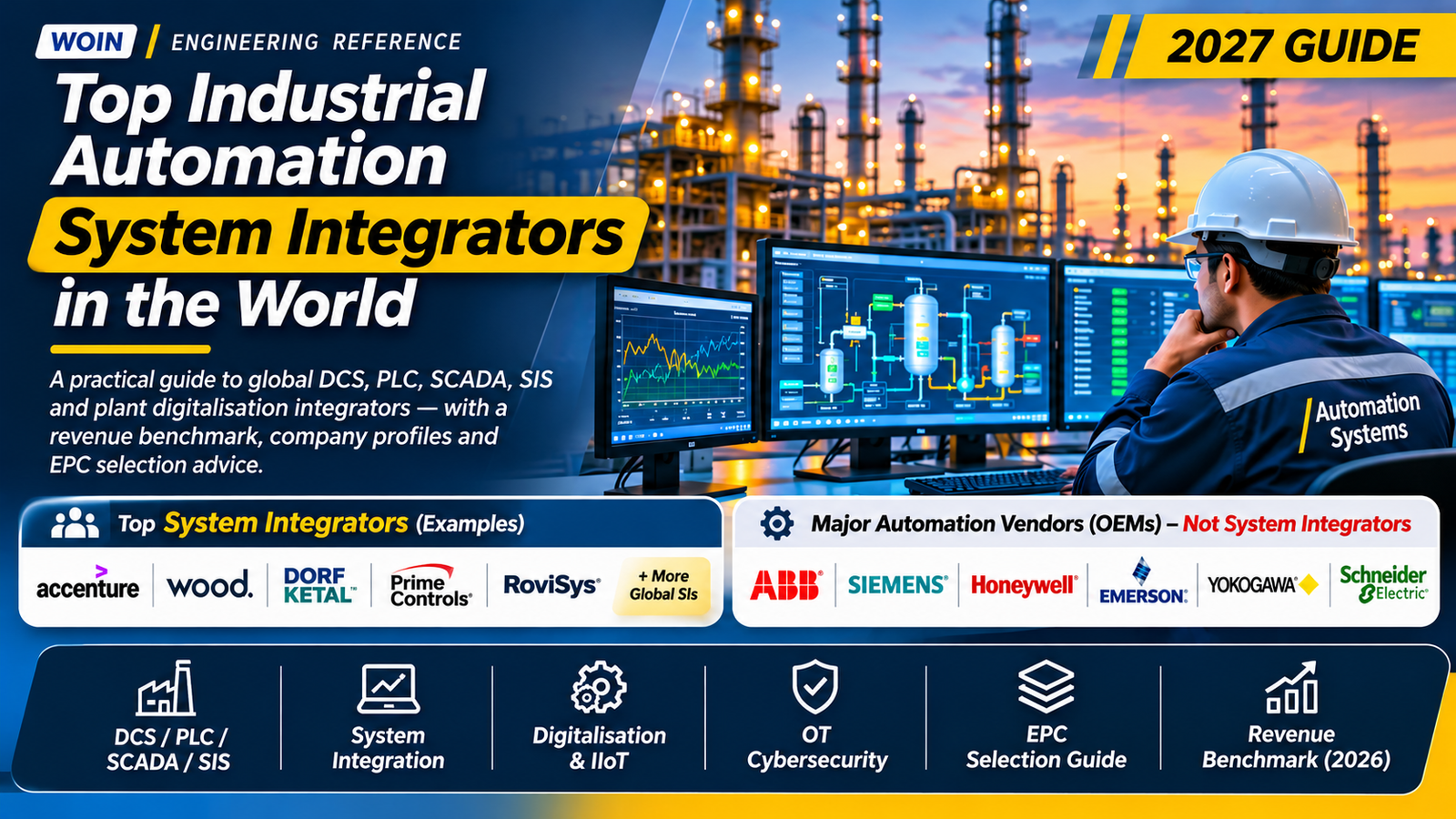
WOIN ENGINEERING REFERENCE · 2027 GUIDE
A practical guide to global DCS, PLC, SCADA, SIS and plant digitalisation integrators — with a revenue benchmark, company profiles and EPC selection advice.
Editorial update: 07 November 2026 · Latest published SI revenue benchmark: 2026
Industrial automation system integrators connect process equipment, instruments, control systems, plant networks and business applications into one working solution. They help owners and EPC contractors design, engineer, program, test, commission and support automation systems across refineries, petrochemical plants, power stations, water facilities and manufacturing sites.
However, there is no single ranking that proves which company is the best system integrator in every country and industry. The size of a company, its system-integration revenue, its technology partners and its experience in a specific process sector are different measures. Therefore, this WOIN guide combines the latest published revenue ranking with a practical shortlist of global and regional firms.
As of 07 November 2026, the latest published Control Engineering “System Integrator Giants” list is the 2026 edition. The publisher states that the 2027 list is scheduled for December 2026. This article uses the 2026 figures as the latest available benchmark; it does not present them as 2027 results.
01Scope and definition
What Does an Industrial System Integrator Do?
An industrial system integrator (SI) brings equipment and software from different suppliers together so that a plant can operate as one coordinated system. In a process plant, the work may begin with control-system architecture and continue through detailed engineering, programming, panel building, factory acceptance testing, installation, commissioning and lifecycle support.
Distributed control systems for continuous and batch process control.
Programmable logic controllers for packaged equipment, machines and interlocks.
Supervisory control, remote monitoring, alarms, trends and data acquisition.
Safety instrumented systems and emergency shutdown integration within the defined safety lifecycle.
Manufacturing execution and operations-management applications.
Industrial networks, historians, cybersecurity and IT/OT integration.
System integrator vs. automation OEM vs. EPC contractor
These business models often overlap, but they are not identical. An automation OEM develops and supplies its own control platform. An independent system integrator can engineer solutions around one or more OEM platforms. An EPC contractor manages a wider project scope and may have its own automation team or subcontract the integration work.
| Company type | Main responsibility | Typical examples | What to check |
|---|---|---|---|
| Independent SI | Integrates controls, networks, software and plant systems, often across multiple OEMs | RoviSys, Prime Controls, Wunderlich-Malec, E Tech Group | Platform competence, project references, resources and lifecycle support |
| Automation OEM | Develops and supplies its own DCS, PLC, SIS, SCADA or automation platform; may also deliver turnkey projects | ABB, Siemens, Emerson, Honeywell, Yokogawa, Schneider Electric | Product lifecycle, compatibility, engineering scope and partner model |
| EPC / engineering | Manages engineering, procurement and construction; may execute control-system integration directly | Wood, Jacobs, Burns & McDonnell | Project boundaries, subcontracting, integration accountability and commissioning |
| Regional specialist | Provides automation integration and site support in a defined region or industry | Cotmac, Avanceon, Actemium business units | Local approvals, engineering depth, local service and global delivery capacity |
02Latest available revenue benchmark
Top System Integrator Companies: 2026 Revenue Ranking
The Control Engineering System Integrator Giants programme ranks participating firms by reported system-integration revenue. The 2026 table includes 75 system integrators. In that edition, ANDRITZ is listed first, RoviSys second and Prime Controls third.
Use the figures below as a useful benchmark of reported SI business size. They are not total company revenue and do not measure engineering quality, safety performance, project outcomes or customer satisfaction.
| Published rank | Company | Reported SI revenue (USD) | Editorial note |
|---|---|---|---|
| 1 | ANDRITZ | $715,717,700 | Automation within a global process and plant technology group |
| 2 | RoviSys | $477,000,000 | Independent process, manufacturing and building automation SI |
| 3 | Prime Controls | $454,166,578 | System integration and I&C construction |
| 4 | Wunderlich-Malec Engineering | $259,036,000 | Employee-owned engineering and integration firm |
| 5 | Quad Plus | $241,000,000 | Industrial engineering, automation and power systems |
| 6 | E Tech Group | $186,000,000 | Automation and control integration across multiple industries |
| — | Wood* | $172,270,000 | Revenue shown; no numbered rank printed in the table |
| 7 | Revere Control Systems | $170,100,000 | Automation, communications and information integration |
| 8 | BW Design Group | $150,000,000 | Engineering, design and systems integration |
| 9 | Thermo Systems | $146,669,060 | Full-service control systems integration and turnkey delivery |
| 10 | SAGE Group | $141,387,742 | Industrial automation and digital transformation group |
| — | Actemium North America* | $121,590,000 | Revenue shown; no numbered rank printed in the table |
| 11 | Cotmac Electronics | $95,052,150 | India-based factory and process automation integrator |
| 12 | Logical Systems | $82,980,000 | Industrial automated control systems integration |
| 13 | Grantek | $79,885,000 | Smart manufacturing, automation and industrial IT |
| 17 | Avanceon Middle East & South Asia | $60,000,000 | Industrial automation and process control for the region |
| 24 | Matrix Technologies | $43,641,972 | Engineering and process automation integration |
| 25 | Jacobs Engineering Group | $43,000,000 | SI revenue reported within a much larger engineering group |
| 28 | Burns & McDonnell | $39,374,751 | Engineering and project delivery with integration capability |
Source: Control Engineering, 2026 System Integrator Giants. The table above reproduces selected entries; it is not the complete 75-company list. Figures and asterisks are reproduced as published. The publisher notes that asterisked revenue figures were corrected after the submission deadline.
The programme ranks firms listed in its Global System Integrator Database by SI revenue. The publisher describes a voluntary submission process. Therefore, the table should not be treated as an audited census of every integrator worldwide. Some companies are shown with a dash instead of a numeric position, so their revenue should not be converted into an assumed rank.
03Global integrator profiles
Leading Industrial Automation System Integrators Around the World
The companies below are selected from the published revenue list and from verified global delivery networks. They are presented by business model and engineering relevance, not as a new WOIN ranking. In particular, some are independent integrators while others are automation groups or engineering contractors with integration divisions.
ANDRITZ Automation — highest reported SI revenue in the 2026 published list.
RoviSys — leading independent integrator with broad process and manufacturing capability.
Prime Controls — strong SI and instrumentation & control construction model.
Wunderlich-Malec — multi-platform engineering and integration capability.
ANDRITZ Automation
ANDRITZ is a global technology and plant engineering group with a dedicated automation business. Its automation team supplies machine and plant control systems for industries such as pulp and paper, mining, cement, power and oil and gas.
The company’s published scope includes quotation engineering, project management, hardware and software engineering, installation, start-up, operator training and lifecycle service. Its portfolio includes the METRIS X distributed control system and plant control solutions.
- Plant and machine control systems
- METRIS X DCS and digital performance services
- Project engineering, installation and commissioning
- Process industries and large plant applications
RoviSys
RoviSys is an independent systems integrator working across process automation, discrete manufacturing, building automation and digital transformation. It designs, integrates and supports solutions using major automation platforms.
Its published industry coverage includes chemicals, petrochemicals, life sciences, metals, power and energy, water, oil and gas, food and beverage, and data centres. It also supports control-system migration and plant information integration.
- DCS, PLC, SCADA, HMI and historian integration
- Batch and continuous process automation
- Legacy control-system upgrades and migration
- Industrial networks, data and digital solutions
Prime Controls
Prime Controls describes itself as a system integrator and instrumentation & control construction firm. This combination can be useful when a project needs control-system engineering alongside field construction, installation and commissioning coordination.
The company supports automation and control projects from multiple US locations. Its profile makes it particularly relevant to project teams looking for an integrated controls and I&C construction scope.
- Industrial automation and control-system integration
- Instrumentation and control construction
- Project execution and field support
- SCADA and process-control services
Wunderlich-Malec Engineering
Wunderlich-Malec is a 100% employee-owned engineering and architecture firm founded in 1981. It specialises in system integration and advanced engineering solutions for a wide range of industries.
The company states that it works across multiple technology vendors rather than favouring one control platform. Its services include electrical, mechanical and IT/OT engineering, design and implementation, with experience serving customers across North America and international markets.
- Multi-vendor control-system integration
- Electrical and mechanical engineering
- IT/OT design and implementation
- Industrial process and manufacturing solutions
Quad Plus
Quad Plus is an industrial engineering services company combining automation system integration, professional engineering and power-system services. It describes its delivery model as covering the full lifecycle, from concept and design through commissioning, maintenance and optimisation.
Its published industry coverage includes oil and gas, metals, mining, cement, pulp and paper, water, utilities, marine, building products and other industrial sectors. The company lists international locations including the UK, Turkey and India.
- Industrial system integration
- Electrical engineering and power services
- Automation upgrades and field service
- Commissioning and long-term optimisation
E Tech Group
E Tech Group provides automation, control and information solutions. Its published profile highlights more than 30 years of experience, over 800 engineers and more than 30 locations, with solutions for industries including life sciences, mission-critical facilities, metals, consumer products and food and beverage.
The company also describes a hardware- and software-agnostic approach. Its services range from staff augmentation and control upgrades to turnkey design-build automation projects, project management, panel building, installation and commissioning.
- Process and manufacturing automation
- Control-system design, integration and upgrades
- Turnkey project and panel-build services
- Information systems and digital transformation
Wood
Wood is a global engineering and consulting company with a dedicated automation, control and systems-integration capability. It supports process and manufacturing industries with control-system upgrades, obsolescence management, automation engineering and OT cybersecurity.
Wood is especially relevant to brownfield plants where control platforms are ageing, spare parts are becoming difficult to obtain, or owners need a phased migration plan that protects plant availability.
- Control-system upgrade and obsolescence strategy
- Process automation and system integration
- OT cybersecurity and digitalisation
- Engineering support for operating assets
Revere Control Systems
Revere Control Systems is an automation, communication and information integrator. Its profile in GE Vernova’s industrial partner directory identifies it as a systems integrator with specialities in HMI/SCADA and historian products, and industry coverage that includes chemical, food and beverage, utilities, manufacturing, mining, oil and gas, power and water.
Revere also combines automation engineering and construction skills in-house. For buyers, this can reduce the number of interfaces between controls engineering and field delivery.
- Automation, communication and information integration
- HMI, SCADA and historian systems
- Water, energy and manufacturing applications
- Engineering and construction delivery
BW Design Group
BW Design Group combines engineering, architecture, construction and system integration. Its system-integration practice describes a vendor-independent approach and a large team of controls and automation professionals supporting discrete, process and packaging automation.
This wider engineering model may be useful where plant automation is linked with facility design, electrical systems, manufacturing processes and construction delivery.
- Industrial automation system integration
- Controls and electrical engineering
- Process, discrete and packaging automation
- Engineering and construction coordination
Thermo Systems
Thermo Systems is a full-service control-systems integration partner. It supports energy, life sciences and mission-critical markets, and provides services from automation design through construction, system integration, installation, commissioning and support.
The company highlights turnkey delivery for EPC and architect-engineer partners. Its scope can include control panels, HMI software, servers, instrumentation and control-valve packages, plus lifecycle support.
- Control-system design and integration
- Turnkey EPC and direct-to-owner delivery
- Energy, life sciences and critical facilities
- Commissioning, validation and lifecycle service
SAGE Group
SAGE Group provides integrated automation, digital transformation, training and specialist engineering services. Its current group profile describes 800 people across two continents and 18 offices, with capabilities across defence, energy, manufacturing, resources, transport and water.
The group includes SAGE Automation and other specialist businesses. Its breadth is relevant when a project needs physical automation, digital systems and workforce skills to be planned together.
- Industrial automation and control systems
- Digital transformation and manufacturing technology
- Engineering and technical workforce support
- Energy, resources, transport and water industries
Actemium
Actemium is the industrial-services brand of VINCI Energies. It operates through local business units and provides consulting, engineering, implementation, commissioning and maintenance for industrial processes. The revenue entry in the 2026 SI Giants table is specifically for Actemium North America, not the entire global Actemium network.
Its published capabilities include process control and automation, electrical engineering, instrumentation, mechanical engineering and process utilities. In oil and gas, Actemium describes projects involving process and safety systems, instrumentation, telecom and industrial network integration.
- Process control and automation
- Instrumentation, electrical and telecom systems
- Oil and gas, refining, chemicals, energy and manufacturing
- Design, build, commissioning and maintenance
Cotmac Electronics
Cotmac is an India-based industrial automation solutions provider with factory and process automation capabilities. Its published service portfolio includes PLC, DCS, drives, SCADA, instrumentation, control-system engineering and EPC projects for electrical, instrumentation and control.
Cotmac states that it has completed more than 11,000 projects in over 70 countries, with offices in Asia and North America and manufacturing units in India. Its industry coverage includes chemicals and pharmaceuticals, energy, power, food and beverage, water and wastewater, automotive and material handling.
- DCS, PLC, SCADA and drive integration
- Instrumentation and control engineering
- Electrical and instrumentation EPC packages
- Factory and process automation
Avanceon
Avanceon provides industrial automation, process control, systems integration, energy management and support services. Its operations cover the Middle East, Pakistan and other regional markets, with projects for oil and gas, power, water, manufacturing and infrastructure.
The company describes work across PLC, SCADA, process control, energy management, OT cybersecurity and lifecycle support. It is a relevant supplier to consider for projects in the Gulf and South Asia, but buyers should check the exact local contracting entity and engineering location.
- Process automation and control-system integration
- PLC, SCADA and energy-management solutions
- Oil and gas, power, water and infrastructure
- Engineering, commissioning and maintenance
ATS Global
ATS Global provides automation and industrial IT system design, architecture, implementation, maintenance and support. It describes itself as platform-independent, which means it can select technology from different automation suppliers to suit the application.
Its published capabilities span PLC, DCS, SCADA, CNC, robotics, MES/MOM, IT/OT convergence, system migration, training and 24/7 support. ATS states that its teams have installation and commissioning experience in more than 75 countries.
- PLC, DCS, SCADA and robotics engineering
- MES/MOM and manufacturing IT
- Control-system migration and upgrade
- IT/OT integration and global support
Grantek
Grantek is a systems integrator focused on smart manufacturing, manufacturing automation, industrial IT and consulting. Its published work covers pharmaceutical, food and beverage, consumer packaged goods and data-centre-related manufacturing needs.
Grantek is particularly relevant where automation integration extends into manufacturing execution, production data, compliance and digital operations. It also reports offices in the United States, Canada and India.
- Manufacturing automation and system integration
- MES and industrial IT / cybersecurity
- Smart manufacturing and data integration
- Life sciences, food and beverage and CPG
Matrix Technologies
Matrix Technologies provides engineering, automation and system integration services. Its work includes process automation, industrial control systems and engineering solutions for manufacturing and process-industry customers.
Matrix is a useful additional company to evaluate when comparing US-based integration firms, particularly for projects that combine process engineering and plant-floor control systems.
- Industrial automation and controls integration
- Process engineering and plant systems
- Control-system design and implementation
- Manufacturing and process-industry support
The 2026 list also includes Logical Systems (#12), Interstates (#14), M.C. Dean (#15), Avanceon Middle East & South Asia (#17), Premier Automation (#18), Multi-Dimensional Integration (#21), Flexware Innovation (#22), EOSYS (#23), Jacobs (#25) and Burns & McDonnell (#28). Their relevance depends on the project type, region and the exact scope offered. Use the publisher’s complete table and each company’s current capability statement before building a bid list.
04OEM-led integration providers
Global Automation OEMs That Also Deliver System Integration
Several global automation companies provide engineering, project execution, system integration and lifecycle services around their own platforms. They are important competitors and partners in process automation projects. However, they should not automatically be compared with independent, multi-vendor system integrators because their business model and technology responsibilities are different.
| Automation supplier | Examples of platform portfolio | What it means for project buyers | Official reference |
|---|---|---|---|
| ABB | Ability System 800xA, Symphony Plus and process automation | Evaluate OEM-led DCS engineering, migration, lifecycle service and partner integration scope. | ABB Control Systems ↗ |
| Siemens | SIMATIC, PCS 7 / PCS neo and industrial digitalisation | Evaluate platform engineering, integration, commissioning and installed-base support. | Siemens Automation ↗ |
| Yokogawa | CENTUM, ProSafe-RS and enterprise technology solutions | Yokogawa entities undertake process-control engineering, project execution and enterprise integration. | Yokogawa ↗ |
| Emerson | DeltaV, Ovation and industrial automation solutions | Assess direct OEM execution versus authorised system-integrator delivery. | Emerson ↗ |
| Honeywell | Experion PKS and industrial safety systems | Check system lifecycle, migration and functional-safety responsibilities. | Honeywell Process Solutions ↗ |
| Schneider Electric | EcoStruxure, Foxboro and Modicon | Review platform design, partner ecosystem and project integration responsibility. | Schneider Industrial Automation ↗ |
The list above is a platform-supplier reference, not a revenue ranking of independent system integrators.
05Project selection
How to Select a System Integrator for an EPC or Plant Project
A high revenue figure or a well-known brand is not enough to approve a system integrator. Instead, assess the company against the project scope, technical platform, operating environment, schedule and long-term support requirements.
- Define the integration boundary. State whether the scope includes DCS, PLC, SIS, SCADA, F&G, telecom, package-unit controls, historian, MES, OT networks, cybersecurity or all of these. Also define the interfaces with the EPC contractor, OEM package vendors and plant owner.
- Check the process-industry experience. Ask for references from similar plants and duties. A team with strong pharmaceutical batch experience may not automatically have the same experience in refinery shutdown systems or offshore facilities.
- Confirm OEM and platform competence. Ask for named engineers, current training or partner status, platform versions and experience with the exact systems installed at the site. Confirm that support is available for legacy versions as well as new platforms.
- Review the engineering deliverables. Define control philosophy, system architecture, I/O database, logic diagrams, cause-and-effect, HMI philosophy, alarm rationalisation, network drawings, cabinet layouts, loop interfaces and test records as applicable.
- Assess functional-safety capability. Where SIS work is included, verify competence in the applicable IEC 61511 / IEC 61508 lifecycle, safety requirements specification, verification, validation, proof-test documentation and independent assessment needs. Do not assume general PLC expertise proves SIS competence.
- Check OT cybersecurity. Review network segmentation, remote access, backup and restore, asset inventory, patch governance, account management, logging and incident response. Map the proposed scope to the project’s adopted IEC 62443 requirements.
- Evaluate execution resources. Confirm engineering hours, lead engineers, panel shop capacity, FAT facilities, site staffing, commissioning shifts, travel support and subcontractor interfaces. Ask how the integrator will handle peak workload.
- Plan migration and cutover. For brownfield projects, require a clear strategy for backups, application conversion, parallel testing, shutdown windows, rollback, operator training and handover.
- Verify quality and project management. Review the project execution plan, document control, change management, design review process, software quality checks, FAT/SAT procedure and open-item closure process.
- Confirm local support and lifecycle costs. Check local response time, spares, software licences, engineering support, warranty, obsolescence management and long-term service rates.
System integrator evaluation scorecard
| Evaluation category | Suggested weight | Evidence to request |
|---|---|---|
| Relevant project experience | 20% | Comparable project references, industry, plant size, scope and completion records |
| Technical capability | 20% | Architecture, design examples, named specialists, platform competence and calculations |
| Project execution | 15% | Project plan, engineering capacity, FAT/SAT, commissioning and change control |
| Safety and cybersecurity | 15% | SIS lifecycle evidence, cybersecurity practices, procedures and competent personnel |
| Quality and documentation | 10% | QMS, document control, software testing and handover records |
| Regional service and support | 10% | Local engineers, response time, service coverage and spares arrangements |
| Commercial and lifecycle value | 10% | Price, exclusions, licences, maintenance, warranty and obsolescence plan |
The weights are an illustrative starting point. Adjust them to match project criticality, contracting strategy, owner requirements and the risk profile.
Do not compare system integrators only by the total contract price. Compare the scope boundary, software ownership, OEM licences, engineering deliverables, FAT/SAT coverage, commissioning manpower, cyber requirements, documentation and lifecycle support. A low initial price can create a larger cost during commissioning or future upgrades.
What does CSIA certification mean?
The Control System Integrators Association (CSIA) offers a certification process based on third-party auditing against its business and management best practices. It examines areas such as project management, system development lifecycle, quality, service, information systems and cybersecurity. This can be a useful business-process screening step. However, it is not a substitute for checking an integrator’s technical capability, sector experience, functional-safety competence or references for the specific project.
Use the CSIA Industrial Automation Exchange to find and compare integrators, and review the CSIA certification requirements.
06Future of integration
What Will Shape Industrial System Integration in 2027?
Industrial system integration is expanding beyond control logic and HMI screens. Owners increasingly expect their integrators to connect operational technology with data platforms while protecting the reliability and security of the core process.
Secure by design
Cybersecurity becomes a design and lifecycle requirement, not a late project add-on.
Brownfield first
Ageing DCS and PLC platforms create demand for safer, phased upgrade programmes.
Connected plant
More projects connect plant information with enterprise systems and operations teams.
Useful plant data
AI and advanced analytics rely on trusted instrumentation, control and asset data.
Interoperability
Owners seek easier integration between equipment, platforms and service providers.
Operate and improve
The integrator’s responsibility increasingly extends beyond commissioning and handover.
07Frequently asked questions
FAQs About Top Industrial Automation System Integrators
In the latest published 2026 System Integrator Giants ranking available on 07 November 2026, ANDRITZ ranks first by reported system-integration revenue, followed by RoviSys and Prime Controls. This does not mean ANDRITZ is objectively the best integrator for every project or that the table covers every company worldwide.
Which is the number one system integrator company in the world?
The 2026 Control Engineering System Integrator Giants list places ANDRITZ first by reported SI revenue. However, no single company can be called the best for every project, region and automation platform.
What is the difference between an SI and an automation OEM?
An OEM develops and supplies its own automation products. An independent SI engineers and connects equipment and software from one or more OEMs. Some OEMs also offer turnkey integration services.
Are the 2027 System Integrator Giants rankings available?
Not as of 07 November 2026. The publisher’s programme page schedules the 2027 announcement for December 2026. The 2026 list is the latest published benchmark used in this article.
Is the System Integrator Giants list a complete world ranking?
No. It ranks firms in the publisher’s Global System Integrator Database based on reported SI revenue. Participation and reporting scope mean it should be read as a published industry benchmark, not a census of every integrator.
Which system integrator is suitable for an oil and gas project?
Shortlist companies with relevant refinery, petrochemical, gas processing or offshore references. Check DCS, SIS, F&G, telecom, package integration, OT cybersecurity, shutdown execution and local site support.
Does CSIA certification guarantee technical expertise?
No. It provides third-party validation of business and management practices. Technical capability still needs to be checked through engineer qualifications, platform credentials, project references and the proposed solution.
Should an EPC contractor select only one system integrator?
Not always. The project may use a main DCS/SIS integrator and specialist package, telecom, SCADA or MES integrators. The key is to define interface ownership and testing responsibility clearly.
What should an instrumentation engineer check in an SI proposal?
Review the system architecture, I/O database, instrument interfaces, control narratives, cause-and-effect, alarms, network design, cabinet layouts, FAT/SAT, commissioning manpower and final documentation.
08References and further reading
Official Sources and Research References
The company descriptions in this guide are based primarily on official corporate capability pages. The revenue benchmark and its methodology are taken from the published Control Engineering ranking and programme information.
WOIN WORLD OF INSTRUMENTATION
Choose a System Integrator by Engineering Fit — Not Just by Name
The strongest system integrator for your project is the one that understands the process, owns the interfaces, has the right platform skills and can support the plant after commissioning. Use the ranking as a starting point, then complete a project-specific technical and commercial evaluation.
Explore more instrumentation and control engineering resources.
Editorial note: This article is an engineering-oriented reference, not a paid endorsement or a complete global market census. Company descriptions reflect public corporate information available at the editorial update date. Rankings and revenues are attributed to their named publisher. Readers should verify legal entities, regional offices, platform authorisations and project references before issuing an RFQ or approving a vendor.
