


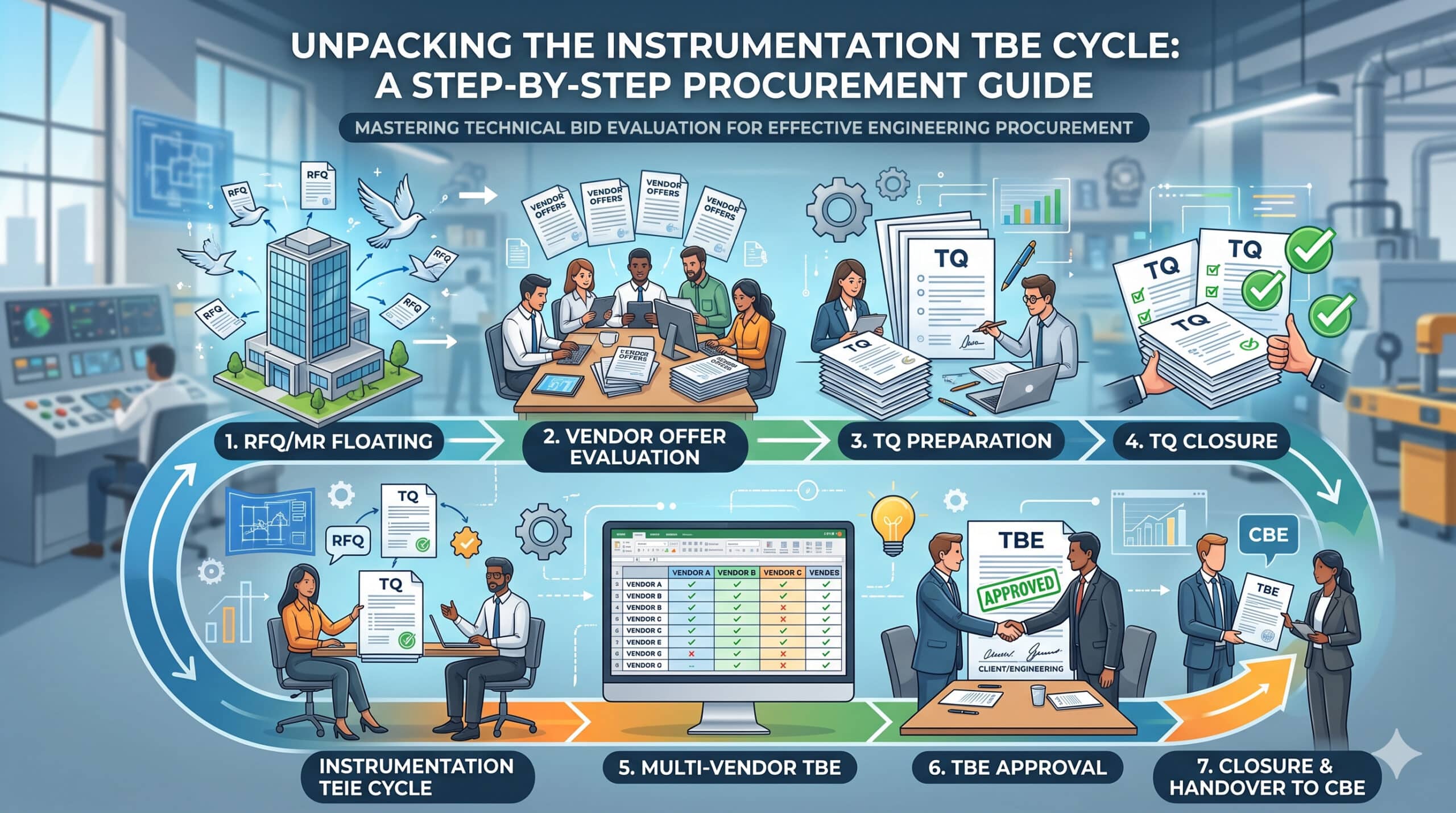
If you’ve sat through an interview for an I&C or procurement engineering role, you’ve probably heard some version of this question: “Walk me through the procurement cycle for an instrumentation package — from requisition to vendor selection.”
It sounds simple. Most candidates fumble it anyway, because they describe it as one flat step instead of a cycle with clear stages — floating the RFQ, evaluating what comes back, closing technical queries, building a multi-vendor TBE, and getting that TBE approved before it ever reaches the commercial team. I’ve sat on both sides of this now, and the projects that run smoothly are the ones where each stage is closed properly before moving to the next. Here’s how the cycle actually runs.
Procurement cycle for an instrumentation package — Step by Step
Before the detail, here’s the full cycle at a glance — this is also exactly how I’d answer that interview question:
- RFQ/MR Floating — package goes out to vendors
- Vendor Offer Evaluation — offers come in, get reviewed line by line
- TQ Preparation — ambiguities get raised as formal queries
- TQ Closure — vendor responses received and reviewed
- Multi-Vendor TBE — all clarified offers compiled into one comparison matrix
- TBE Approval — client/engineering signs off on technical compliance
- Closure & Handover to CBE — package moves to procurement for commercial evaluation
Step 1 — RFQ / MR Floating
The cycle starts when the Material Requisition (MR) is floated to vendors as part of the RFQ package. A weak RFQ here guarantees a messy evaluation later, because vendors fill gaps with their own assumptions — and those assumptions rarely match what you intended.
A complete instrumentation RFQ package carries:
- The MR — data sheets, relevant P&ID extracts, hook-up details, material specs
- Project Specifications — the base standard (ISA, API, ASME, IEC depending on the item) plus the client’s project-specific amendments
- Scope of Supply — exactly where the vendor’s responsibility starts and ends
- Instruction to Bidders (ITB) — closing date, submission format, query contact point
Quick tip: Scope of Supply is where instrumentation packages most often go wrong. “Does the DP transmitter bid include the manifold, mounting bracket, and SS tubing, or just the bare instrument?” Pin this down before floating, or you’ll get three vendors quoting three different scopes.
My suggestion you can share prefilled TQ along with MR which significant reduce your TQ cycle and you can able to do close TQ fast is it my personal experience.
Step 2 — Vendor Offer Evaluation
Once offers land, the first pass isn’t the full TBE matrix yet — it’s a read-through of each vendor’s offer against the MR to spot what’s compliant, what’s ambiguous, and what’s clearly missing. This is where you decide which items need a Technical Query before you can categorize anything properly.
Treat this as triage, not final judgment. You’re sorting offers into “clear enough to evaluate” and “needs clarification first” — the actual deviation categorization comes after queries are closed.
Step 3 — TQ Preparation
For anything ambiguous, I draft a formal Technical Query (TQ) rather than guess at vendor intent. Here’s what most engineers get wrong — they assume what the vendor meant instead of asking, and that assumption surfaces three weeks later as a costly surprise.
A good TQ is specific and closes the ambiguity in one round if possible: cite the MR line item, state what’s unclear, and ask a direct question the vendor can answer with a yes/no or a number — not an open-ended “please clarify your offer.”
Step 4 — TQ Closure
A TQ isn’t closed until the vendor’s response is reviewed and either resolves the ambiguity or confirms a genuine deviation. I log every TQ and its closure status before that vendor’s offer moves into the TBE matrix — an open TQ means that offer isn’t ready for comparison yet.
Note: If a vendor doesn’t respond before the evaluation deadline, don’t quietly assume compliance. Flag it as unresolved in the matrix rather than guessing in the vendor’s favor.
Step 5 — Multi-Vendor TBE
This is where everything comes together. With TQs closed, I build one matrix with the MR as the “Base Case” in one column and every bidder’s offer in the next — range, accuracy class, material of construction, certification, every line item that matters for that instrument. Anything that doesn’t match the base case is flagged as a deviation and sorted:
Case 1 — Category A (Minor deviation): Acceptable as-is. Example: vendor offers a slightly different cable entry size that still meets the area classification requirement. No escalation needed — note it and move on.
Case 2 — Category B (Major deviation): Needs engineering review before acceptance. Example: vendor proposes a different sensing technology or a range that doesn’t match your process conditions. This goes back to the design engineer — not a solo call.
Case 3 — Category C (Critical deviation): Technical rejection. Example: offered material of construction doesn’t meet specified service conditions, or a required certification — say, SIL capability for a safety loop — is missing. No negotiation path here, regardless of price.
(Verify your project’s exact deviation categorization criteria against your client’s procurement procedure — the A/B/C labels and what falls into each can shift slightly project to project.)
A Worked Example — Comparing Two Vendors in the TBE Matrix
(This is an illustrative example for demonstration — not actual project data.)
RFQ issued for a DP transmitter, flow service, range 0–500 mmWC, SS316 wetted parts, HART output.
| Item | Base Case (MR)/ Datasheet | Vendor A | Vendor B |
|---|---|---|---|
| Range | 0–500 mmWC | 0–500 mmWC | 0–600 mmWC |
| Wetted Parts | SS316 | SS316 | SS316 |
| Output Protocol | HART | HART | HART + Foundation Fieldbus option |
| Accuracy | ±0.075% | ±0.065% | ±0.1% |
| Manifold Included | Yes | Yes | No (quoted separately) |
Illustrative multi-vendor TBE comparison — DP transmitter package
Vendor A meets or beats the base case across the board — straightforward compliant offer. Vendor B’s range deviation (0–600 vs. 0–500 mmWC) needs a Category B check — does the wider range still give usable turndown at minimum flow? And the missing manifold isn’t a technical deviation at all — it’s a scope gap that gets normalized into price later, not decided here.
Before preparing the TQ my personal experience i am sharing pls collect all the VTA data as mention in the Datasheet from vendor don’t assume anything.
Step 6 — TBE Approval
The compiled matrix, with every deviation categorized and every TQ closed, goes to the client or lead engineer for formal approval. This is the technical sign-off point — once approved, the technical compliance status of each vendor is locked. Nobody reopens a Category C rejection later because a price looked attractive; that’s exactly the discipline this approval step protects.
Step 7 — Closure & Handover to CBE
With TBE approved, the package is technically closed and handed to the procurement/commercial team for Commercial Bid Evaluation (CBE). From here, price, payment terms, and delivery get compared — but only among vendors who survived the technical gate. This handoff is the clean break between “does it work” and “what does it cost,” and keeping that separation intact is what stops commercial pressure from quietly overriding engineering judgment.
Common Mistakes I’ve Seen (Pro Tips)
- Vague Scope of Supply at the floating stage — leads to apples-to-oranges offers and wasted cycles later
- Skipping TQ closure before building the TBE matrix — an unresolved query shouldn’t be sitting inside a “compliant” column
- Letting price influence categorization — a Category C rejection stays rejected even if it’s the cheapest offer; keep TBE and CBE strictly separate
- Not documenting deviation rationale — six months later, nobody remembers why something was accepted as Category A instead of B; write the reason into the matrix itself
EndNote
The Procurement cycle for an instrumentation package cycle is where engineering judgment earns its seat at the table — it’s risk control before the money conversation even starts, not paperwork between RFQ and PO. Note: final acceptance of any deviation should still go through your project’s formal MOC/engineering sign-off process — this covers how the evaluation flows, not a substitute for your client’s procedure.
Have you run into a deviation call that was tougher to categorize than it looked on the matrix? Drop it in the comments — always good to compare notes.
you like this article, and if you want to know about thermowell design engeeing. Check out my previous article.
And you can also follow our LinkedIn group which is specially made for sharing information related to Industrial Automation and Instrumentation.
