


Every week, I was manually calculating pressure gauge ranges — one by one, for every single tag on the instrument list. It wasn’t until I started exploring AI for instrumentation engineers that I built a small app to do the entire batch in one shot. That one change saved me hours across a project. That’s when I realised — AI isn’t a threat to core engineers. It’s the sharpest tool you’re not using yet.
Then I built a small AI-assisted app that does the entire batch in one shot. That one change saved me hours across a project. That’s when I realised — AI isn’t a threat to core engineers. It’s the sharpest tool you’re not using yet.
If you’re a fresher or junior I&C engineer trying to figure out where AI fits in your world, this article is written for you.
Why AI for Instrumentation Engineers Is No Longer Optional
Most engineers assume AI is something only software developers or data scientists use. That’s a mistake I see freshers make all the time.
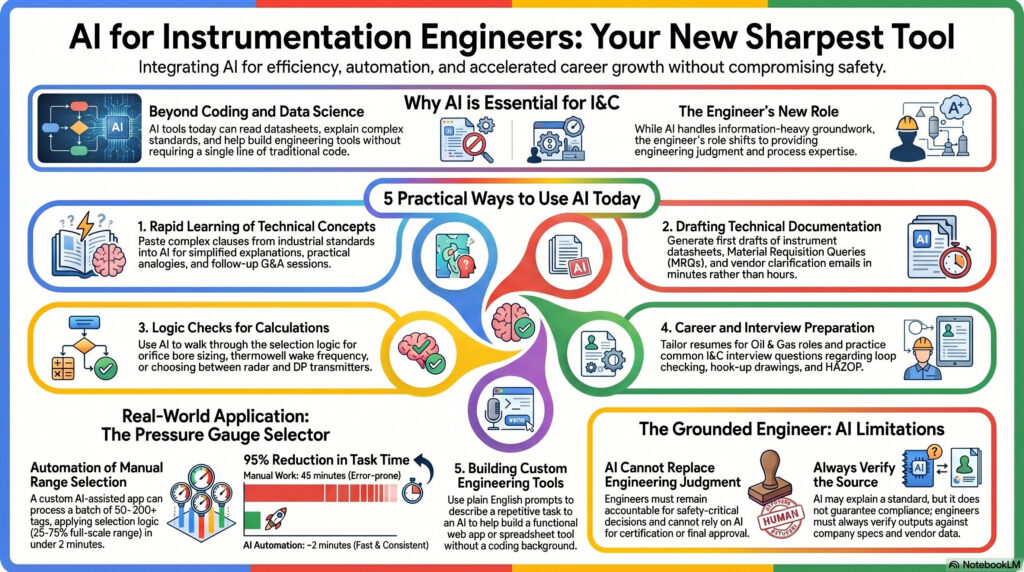
AI tools today can read a datasheet, explain a standard, help you draft a technical query, check your calculation logic, and even help you build a working tool — without writing a single line of traditional code. The barrier is gone. What’s left is knowing where to apply it.
Your job as an I&C engineer doesn’t change. You still need to understand the process, know your instruments, and apply the right engineering judgment. But AI can handle the repetitive, information-heavy groundwork so you can focus on what actually requires your brain.
5 Real Ways I&C Engineers Can Use AI Today
1. Learning and Understanding Technical Concepts Fast
When I was a fresher, I’d spend an entire evening trying to understand a single paragraph in a standard. Today, you can paste that paragraph into an AI tool and ask: “Explain this in simple terms for a junior instrumentation engineer.”
It works. You get a clean explanation, a practical analogy, and you can follow up with questions. Think of it as a patient senior engineer sitting next to you at midnight — one who never gets tired of your questions.
Use it to understand:
- Instrumentation standards and clauses
- Process datasheets and piping specs
- Control philosophy documents
- Vendor technical bulletins
Note: Always verify what AI tells you against the actual standard or your company’s specification. AI explains — it doesn’t certify.
2. Drafting Datasheets, MRQs, and Technical Documents
Junior engineers spend a huge amount of time on documentation. AI can cut that time significantly.
You can use AI to:
- Draft the first version of an instrument datasheet from a process datasheet
- Write a Material Requisition Query (MRQ) covering points for a specific instrument type
- Summarise vendor documents into key technical points
- Write technical clarification emails to vendors
You still review and approve everything. But going from a blank page to a solid first draft in 10 minutes versus 2 hours — that compounds fast over a project.
3. Quick Calculations and Instrument Selection Logic
This is where AI genuinely earns its place on your engineering desk.
Need to check orifice bore sizing logic? Want to run a quick thermowell wake frequency check? Need to understand the selection criteria for a differential pressure transmitter versus a guided wave radar? AI can walk you through the logic step by step, with the right engineering reasoning.
What does this mean in practice? It doesn’t replace your calculation software or your final stamp of approval. But it helps you think through the problem correctly before you sit down to calculate — and that catches mistakes early.
4. Career — Resumes, Interview Prep, and Job Research
Here’s something nobody talks about openly: AI is an unfair career advantage if you use it well.
As a fresher going into interviews for oil & gas or petrochemical projects, you can use AI to:
- Tailor your resume for a specific job description
- Prepare answers to common I&C interview questions (loop checking, hook-up drawings, cause & effect, HAZOP participation)
- Research companies and projects before interviews
- Understand what skills a senior engineer role actually requires — so you can plan your next 2 years
I’ve done this myself. The quality of preparation you can achieve in one evening with AI is something that used to take weeks of senior mentoring.
5. Building Your Own Engineering Tools — No Coding Needed
This is the part that excited me the most when I first tried it.
You can describe a problem to an AI tool — in plain English — and ask it to help you build a working web app or spreadsheet tool. No traditional coding background required. You describe the logic, it helps you build the structure, and you can deploy something real.
Which brings me to something I built myself.
Real Example From My Desk — Pressure Gauge Range Selector
On any mid-size project, you can have 50 to 200+ pressure gauges. For each one, you need to select the correct range based on the operating pressure — following standard selection logic (typically, operating point should fall between 25% and 75% of full-scale range, with specific rules for pulsating service).
Before, I was doing this manually — tag by tag. Even with a spreadsheet, it was repetitive and error-prone when you’re tired.
I built a Pressure Gauge Range Selector app that takes your entire instrument list as a batch input — operating pressures, service conditions — and gives you the recommended gauge range for every tag in one shot.
What used to take 30–45 minutes of focused work now takes under 2 minutes. Across a project, that’s hours back in your hands.
And this is just one tool. Every repetitive engineering task you do regularly is a candidate for something similar.
A Specific AI Skill Built for I&C Engineers
Beyond general AI tools, I’m developing something more focused — a dedicated AI Skill file built specifically for instrumentation and control workflows. Think of it as a structured prompt system that tells an AI exactly how to behave when helping with I&C tasks: instrument selection logic, datasheet review, calculation checks, and more.
I’ll share more details on this soon. If you’re interested, drop a comment below or reach out directly.
What AI Cannot Do — Stay Grounded
I want to be straight with you here, because this matters.
AI cannot:
- Replace engineering judgment on safety-critical decisions
- Guarantee standard compliance — it can explain, not certify
- Verify vendor data — always go to the source
- Take responsibility for your calculation or design
In instrumentation, especially on safety instrumented systems (SIS) or hazardous area equipment, the engineer is accountable. AI is your assistant, not your approver.
Use it to go faster and learn deeper — but always apply your own engineering mind before anything leaves your desk.
EndNote
Not every fresher gets that. AI, used well, can partly fill that gap — giving you access to explanations, tools, and preparation that used to require years of mentorship.
The engineers who will move fastest in the next decade are not the ones who resist AI. They’re the ones who learn to use it with engineering discipline.
If you’ve already started using AI in your instrumentation work — I’d love to hear how. Comment below and let’s build a conversation around this.
And if you’re interested in the Pressure Gauge Range Selector app or the I&C AI Skill file, stay tuned — more coming soon on WOIN.
you like this article, and if you want to know about salary of instrumentation engineer. Check out my previous article.
And you can also follow our LinkedIn group which is specially made for sharing information related to Industrial Automation and Instrumentation.
