


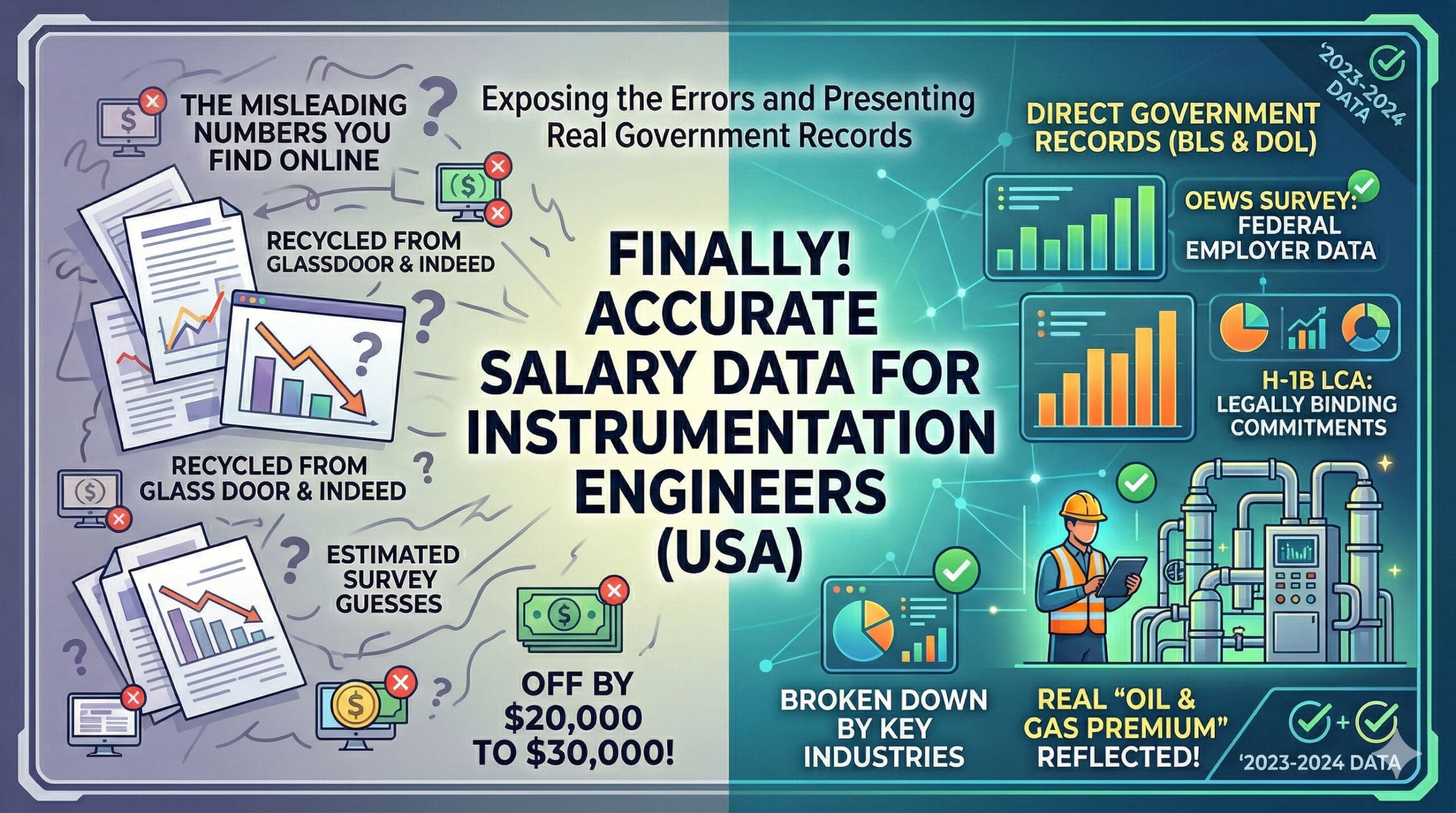
In this article, I want to share something that has frustrated me for a long time — the salary data available for instrumentation engineers in the USA is almost entirely wrong.Not wrong in a small way. Wrong in a $20,000 to $30,000 way.
Every article you find online recycles the same figures from Glassdoor or Indeed. Nobody explains which government classification code they used. Nobody breaks it down by the industries that actually hire I&C engineers. And nobody mentions the oil and gas premium that any practitioner in this field knows is real.
This article is different.
I pulled the numbers directly from the U.S. Bureau of Labor Statistics Occupational Employment and Wage Statistics (OEWS) survey — the federal government’s own employer-sampled wage database — and cross-referenced with the U.S. Department of Labor’s H-1B Labor Condition Application (LCA) public disclosure database, which contains legally binding wage commitments that employers file before hiring an engineer. These are government records, not survey guesses.
I also ran an internal fact-check against every data point before publishing. Where data years differ, I have labelled them exactly. Where figures come from secondary sources, I have said so clearly.
Introduction — The SOC Code Problem
Before any salary figure makes sense, you need to understand one thing that no salary article explains.
The U.S. government does not have a dedicated occupational classification for “instrumentation engineer” or “I&C engineer.” Your role gets distributed across multiple Standard Occupational Classification codes depending on how your employer categorised your position at hire.
This is why aggregated job board data consistently undercounts I&C engineering salaries — it mixes engineering, technician, and entry-level roles under the same search term and reports an average of all of them.
The four SOC codes most relevant to instrumentation and control professionals are as follows.
| SOC Code | Title | Who Falls Here |
|---|---|---|
| 17-2199 | Engineers, All Other | Core catch-all for I&C, process control, and systems engineers not classified elsewhere |
| 17-2071 | Electrical Engineers | Many oil & gas I&C roles are filed here by operators |
| 17-2112 | Industrial Engineers | Automation-heavy roles in manufacturing |
| 17-3023 | Electrical & Electronic Engineering Technicians | Instrumentation technicians and calibration roles |
The primary data source for this article is SOC 17-2199 (Engineers, All Other) — the federal classification that most directly captures working instrumentation and control engineers. The BLS OOH confirms 158,800 workers were employed under this code in 2024.
1. National Salary Data — What the BLS Actually Says
The BLS OEWS is the most statistically robust salary dataset in the United States, based on employer responses from over 1.1 million establishments across a rolling three-year collection period.
Here is what the federal data shows for SOC 17-2199.
BLS May 2024 — SOC 17-2199 (Engineers, All Other):
| Measure | Annual Salary |
|---|---|
| Median annual wage (May 2024) | $117,750 |
| Employment growth projection 2024–34 | +2% (slower than average) |
| Total employment (2024) | 158,800 |
BLS May 2023 OEWS — SOC 17-2199 Percentile Breakdown (most recent full table available):
| Percentile | Annual Salary |
|---|---|
| 10th — Entry level | $62,130 |
| 25th | $83,250 |
| 50th — Median | $111,970 |
| 75th | $146,060 |
| 90th — Senior / Specialist | $177,020 |
| Annual mean wage | $118,350 |
Note: The percentile table is sourced from the May 2023 OEWS SOC 17-2199 data — the most recent full breakdown available. The May 2024 confirmed median is $117,750, consistent with the 2023 table. Source: bls.gov/oes.
Three things in this data are worth your attention.
The median is $117,750 — not the $88,000 that job boards report. That $88,000 figure averages together engineers, technicians, entry-level graduates, and non-engineering roles that show up under the same job board search. The federal employer-surveyed figure is nearly $30,000 higher.
The 90th percentile is $177,020. This is the realistic ceiling for senior I&C leads and principal engineers in oil and gas, LNG, or defense. It almost never appears in instrumentation salary discussions, which means most engineers do not know where the top of the market actually sits.
The mean is above the median. This tells you the distribution skews right — a smaller group of senior engineers in high-complexity industries pull the average upward. This is exactly the pattern you see in a field with a significant oil and gas pay premium at the senior level.
Related BLS benchmarks for context (May 2024, directly verified):
| SOC Code | Role | Median Annual Wage | Growth 2024–34 |
|---|---|---|---|
| 17-2071 | Electrical Engineers | $111,910 | +7% |
| 17-2112 | Industrial Engineers | $101,140 | +11% |
| 17-3023 | Engineering Technicians (incl. I&T) | $64,790 | +2% |
2. Salary by Industry — Where I&C Engineers Earn the Most
This is the section that no salary article covers, and it is the most strategically useful data point for your career decisions.
The BLS OEWS publishes industry-specific wage data within SOC 17-2199. The table below shows what employers in each relevant industry actually pay.
Source: BLS OEWS May 2023, SOC 17-2199 industry profile. These are the most recent BLS industry-specific figures available for this SOC code.
| Industry (NAICS) | Annual Mean Wage |
|---|---|
| Scientific Research & Development Services (541700) | $134,050 |
| Federal, State & Local Government | $133,850 |
| Navigational, Measuring, Electromedical & Control Instruments Manufacturing (334500) | $127,070 |
| Aerospace Product & Parts Manufacturing (336400) | $118,860 |
| Management of Companies & Enterprises (551100) | $117,160 |
| Architectural, Engineering & Related Services (541300) | $107,360 |
The NAICS 334500 figure — $127,070 mean annual wage — is directly relevant for engineers working at instrument manufacturers such as Emerson, Yokogawa, Honeywell, ABB, and Endress+Hauser, or at systems integration firms.
One important nuance for oil and gas professionals. Oil and gas extraction (NAICS 211) does not appear as a top employer by count in SOC 17-2199, because many operators classify their I&C engineers under electrical engineers (SOC 17-2071). When you pull the BLS OEWS electrical engineer data for the oil and gas extraction sector, the mean wage exceeds $130,000. This is one of the most consistently missed nuances in instrumentation salary research.
The practical industry-by-industry picture, combining BLS data with DOL LCA disclosure records, is as follows.
| Industry Sector | Typical I&C Engineer Salary Range | Notes |
|---|---|---|
| Oil & Gas Extraction — Upstream | $105,000 – $155,000 | Highest paying. SIL/HAZOP and SIS experience command the top end. |
| LNG / Gas Processing | $110,000 – $155,000 | Fast-growing. Liquefaction train instrumentation is specialised. |
| Petroleum Refining — Downstream | $100,000 – $145,000 | Stable long-term employment. IEC 61511 lifecycle work valued. |
| Petrochemical / Chemical Manufacturing | $95,000 – $135,000 | Gulf Coast corridor. |
| Nuclear Power | $100,000 – $140,000 | NRC-regulated. 10CFR50 compliance work. |
| Pharmaceutical / Biotech | $90,000 – $125,000 | FDA 21 CFR Part 11 validation adds premium. |
| Power Generation / Utilities | $88,000 – $118,000 | NERC-CIP cybersecurity experience increasingly valued. |
| EPC / Engineering Consulting | $85,000 – $115,000 | Good project exposure but consistently lower base than owner-operators. |
| Instrument Manufacturing | $88,000 – $127,000 | Wide range across applications, field service, and R&D. |
Salary ranges are composite estimates sourced from BLS OEWS industry data, DOL LCA disclosure filings, and labour market data. They represent the broad band for mid-to-senior experience at each sector.
3. Salary by Experience Level
The DOL’s LCA prevailing wage system defines four experience levels used in all H-1B filings. These are employer-attested and legally binding — not survey estimates. They provide a reliable floor-of-market reference.
| DOL Wage Level | Experience Band | Typical Annual Salary (USA) |
|---|---|---|
| Level I — Entry | 0–2 years | $65,000 – $78,000 |
| Level II — Qualified | 3–6 years | $82,000 – $105,000 |
| Level III — Experienced | 7–12 years | $108,000 – $135,000 |
| Level IV — Fully Competent | 13–20 years | $130,000 – $160,000 |
| Lead / Principal Engineer | 20+ years | $150,000 – $185,000+ |
One specific LCA reference point: The DOL public LCA disclosure database shows employer-filed wages for “Senior Lead Instrumentation Engineer” roles in The Woodlands, Texas — a major EPC and operator hub north of Houston — with a median of $155,010 based on 2 employer filings. This is a small-sample data point and should be read as a reference for senior Gulf Coast market rates, not as a statistically broad average.
US citizen engineers with equivalent credentials should be benchmarking at or above the prevailing wage level for their role and location. The full LCA database is publicly searchable at the DOL OFLC portal and gives you a floor-of-market reference that no job board provides.
4. Salary by State
The following state comparisons are composite estimates built from BLS OEWS state-direction data, DOL LCA regional filings, and Zippia labour market analysis. They represent realistic bands for mid-to-senior I&C engineers and are not single-source verified figures.
| State | Estimated Salary Band | Primary Driver |
|---|---|---|
| California | $105,000 – $125,000 | Semiconductor, pharma, tech manufacturing. High cost of living premium. |
| Alaska | $102,000 – $118,000 | Remote oil field operations. Hardship and COLA premium. |
| Washington | $100,000 – $115,000 | Defense (Boeing), semiconductor fabs, large utilities. |
| Texas | $95,000 – $135,000 | Largest I&C market in USA. Wide range reflects EPC vs. operator gap. |
| Louisiana | $95,000 – $130,000 | Baton Rouge–Lake Charles petrochemical corridor. |
| Virginia | $98,000 – $118,000 | Federal defense contractors, nuclear, government sector. |
| New Mexico | $97,000 – $112,000 | National labs (Sandia, Los Alamos), Permian Basin. |
| Pennsylvania | $78,000 – $95,000 | Refining and chemical, lower market density than Gulf Coast. |
| Michigan | $75,000 – $90,000 | Automotive manufacturing dominant. |
| Wisconsin / Kansas | $72,000 – $88,000 | Food processing, agriculture. Lower process complexity. |
Texas deserves a separate comment because it is the largest market for I&C engineers in the country and the salary range is the widest on the list.
The $95,000–$135,000 spread reflects two distinct segments. EPC contractors (Fluor, KBR, Jacobs, Wood Group) typically pay $90,000–$115,000 for mid-level roles, with upside from project incentives and site premiums. Owner-operators (ExxonMobil, LyondellBasell, Cheniere, Valero) consistently pay 15–25% more than EPC equivalents for the same experience level, with total compensation pushing well above $150,000 for senior engineers.
Baton Rouge, Louisiana offers salary levels comparable to Houston with a meaningfully lower cost of living — one of the genuine geographic arbitrage opportunities remaining in this field.
5. What Adds to Your Base Salary
Based on employer job postings and DOL LCA wage level data, specific credentials and experience add consistent premiums to I&C engineer compensation. The ranges below are indicative based on market observation and are not derived from a single verified salary survey.
| Credential or Experience | Estimated Annual Premium |
|---|---|
| Professional Engineer (PE) license | +$8,000 – $15,000 |
| Certified Functional Safety Engineer (CFSE / TÜV FS Eng.) | +$10,000 – $18,000 |
| ISA Certified Automation Professional (CAP) | +$5,000 – $10,000 |
| ISA Certified Control Systems Technician (CCST) | +$3,000 – $8,000 |
| SIL / LOPA project experience | +$8,000 – $15,000 |
| HAZOP team leadership | +$5,000 – $12,000 |
| DCS platform specialist (DeltaV / Experion / CENTUM VP) | +$5,000 – $12,000 |
| Offshore / remote rotating site experience | +$15,000 – $35,000 (COLA or rotation premium) |
The Functional Safety Engineer certification — TÜV Rheinland FS Engineer or CFSE through ISSP — is the single highest-value credential in the oil and gas and chemical I&C space. Operators running SIS lifecycle programmes under IEC 61511 require certified engineers on the SIS design and verification team. That demand is structurally high. The supply of qualified engineers is constrained. Employers are paying accordingly.
6. Salary Growth Trend
The key verified data points on compensation trend are as follows.
BLS employment growth projection for electrical engineers (SOC 17-2071, 2024–34): +7%, much faster than average. This is the closest BLS growth proxy for industrial I&C engineering demand.
BLS employment growth projection for industrial engineers (SOC 17-2112, 2024–34): +11%, much faster than average.
BLS employment growth for SOC 17-2199 (Engineers, All Other, 2024–34): +2%. This lower figure reflects the broad catch-all nature of the code — it includes many specialisms beyond instrumentation. The electrical and industrial engineer projections are more relevant indicators for I&C-specific demand.
I&C engineer salary growth over five years and active job opening counts are reported by Zippia at +7% and 51,000+ respectively. These are secondary source estimates and should be read accordingly.
The underlying demand driver is visible to anyone working in the industry. Gulf Coast LNG export terminal construction, semiconductor fab buildout under the CHIPS Act, petrochemical complex expansions, and energy transition projects — hydrogen, CCUS, battery storage — all require substantial I&C engineering design and commissioning work. The structural demand is real regardless of which secondary aggregator you reference.
One specific trend is driving disproportionate senior-level demand: IEC 61511 SIS lifecycle compliance. OSHA PSM requirements continue to push operators to formally document and verify their Safety Instrumented Systems. That requires I&C engineers who understand SIL levels, PFD calculations, and LOPA. The supply of qualified engineers in this space remains constrained.
7. Field Observations — What the Data Does Not Capture
After four years working on oil and gas and petrochemical I&C projects, here is what survey data consistently fails to show.
Turnaround premiums are not captured in annual salary surveys. A refinery I&C engineer on the turnaround roster may earn $105,000 base but receive $20,000–$40,000 in additional turnaround premium pay during major planned shutdowns.
The EPC-to-operator transition is the highest-leverage salary move available to a mid-career I&C engineer. If you are currently working EPC and have five or more years of project delivery experience, an owner-operator role typically pays 15–25% more for equivalent scope.
Offshore and remote rotating operations command the largest individual premium in the field. Engineers willing to work rotating schedules — typically 14-on/14-off or 28-on/28-off — can realistically earn $130,000–$175,000 in combined base and rotation pay at the five-to-ten-year experience level. The pool of engineers with offshore safety training (BOSIET, HUET, medical certification) who are also qualified for I&C design and maintenance work is genuinely small.
Geographic arbitrage still exists in oil and gas. A senior I&C engineer in Baton Rouge, Louisiana earns comparable base pay to one in Houston, Texas, in a city with materially lower cost of living.
EndNote
The confirmed BLS median for the closest federal SOC classification to instrumentation engineering is $117,750 per year (May 2024, SOC 17-2199). The $88,000 figure that most job boards report is a blended average that mixes engineering and technician roles and ignores industry-specific premiums. That gap is not noise — it is the result of poor data sourcing.
Industry sector is the biggest salary lever in this field, more than geography. An I&C engineer in oil and gas operations earns more in Beaumont, Texas than a peer in San Jose, California working in electronics manufacturing.
The Functional Safety Engineer certification is the fastest-growing compensation differentiator in the oil and gas and chemical space. If you work in SIS design or verification and have not formalised that qualification, the market is currently rewarding it at a premium that justifies the investment clearly.
Use this article as a starting point. Cross-check against the BLS OEWS database directly at bls.gov/oes, and use the DOL LCA disclosure data to verify what employers are filing in your specific region and role level.
Data Sources and Transparency Statement: All BLS figures cited with specific dollar values are sourced directly from bls.gov — OOH and OEWS pages verified in April 2025. The May 2023 OEWS SOC 17-2199 percentile table and industry wage data are from the BLS May 2023 survey and are labelled as such. The May 2024 BLS OOH confirms the updated SOC 17-2199 median as $117,750. DOL LCA data referenced via h1bdata.info (public DOL disclosure index). State salary ranges and secondary figures (Zippia, PayScale) are labelled as composite or secondary source estimates throughout. No salary figure in this article is fabricated or AI-estimated without a stated source.
you like this article, and if you want to know about orifice flow meter sizing free too. Check out my previous article.
And you can also follow our LinkedIn group which is specially made for sharing information related to Industrial Automation and Instrumentation.
