



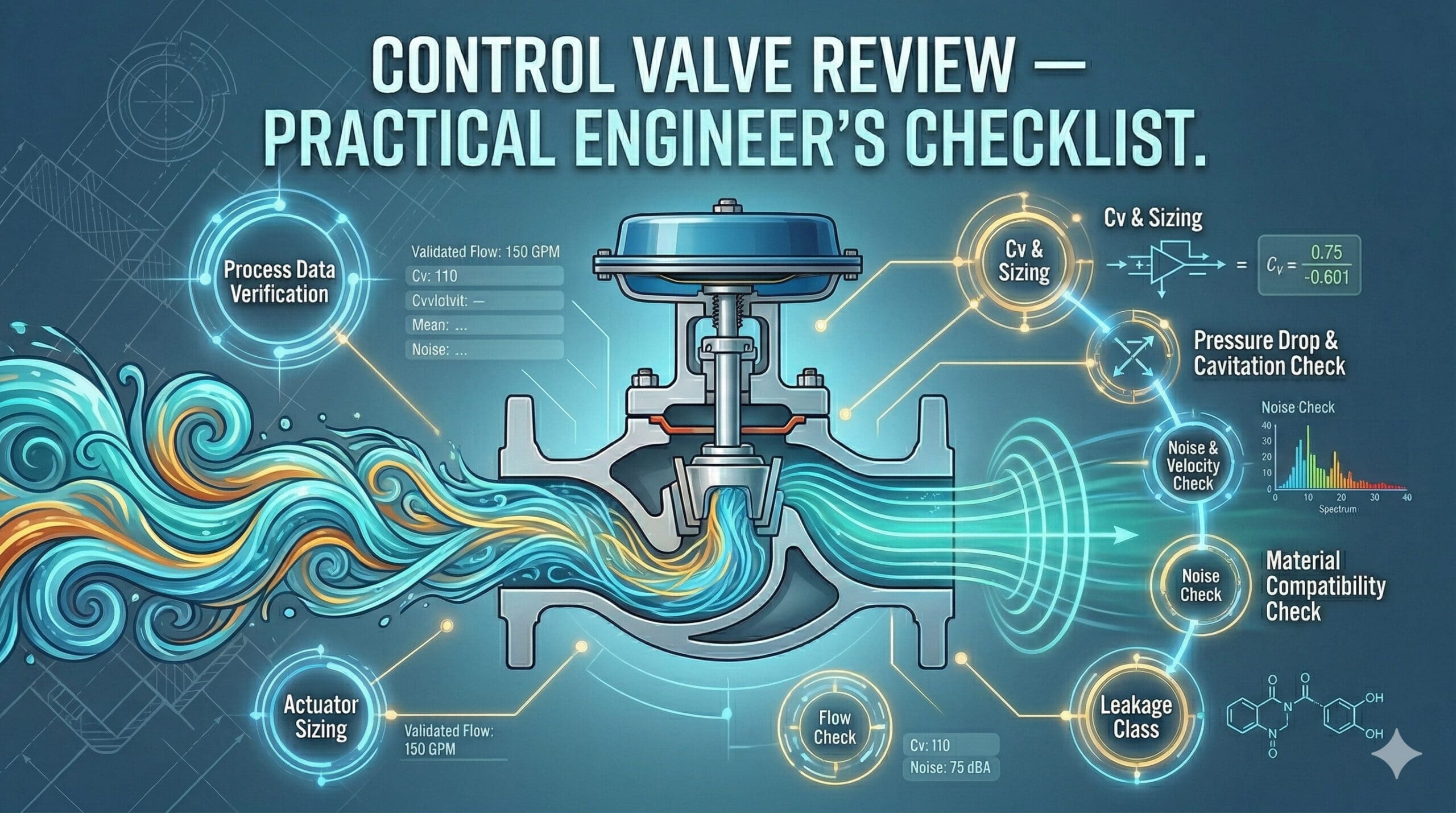
In this article, I want to share the structured approach I use when reviewing a control valve vendor submission on a project. This is not a theoretical exercise — it is a real working checklist that I have built from experience, mistakes, and lessons learned across multiple projects.
When a vendor submits a control valve data sheet, the instrument engineer’s job is not just to tick that the document has arrived.
You are the last line of technical defence before that valve gets fabricated and installed in a process where it needs to perform reliably for twenty-five years.
A bad review produces an oversized valve hunting at 15% travel, or a valve that cannot shut off, or an actuator that stalls on low instrument air. Every one of those failures is avoidable — if you know what to look for.
This article walks through eleven checkpoint areas, covering process data, sizing, materials, trim, noise, actuator, outlet velocity, shutoff safety, fugitive emissions, and two-phase flow.
Introduction
A control valve review is only as good as the engineer doing it. The data sheet is a vendor document — it is optimised to pass, not necessarily to be correct. Your role is to independently verify the key technical decisions and catch the things that would only show up as a problem after commissioning.
The eleven checks below are structured in the order I work through them on a real project.
I have referenced them against ISA-75.01.01, ISA RP75.23, ANSI/FCI 70-2, ISO 15848, the Fisher Control Valve Handbook (CVH), Baumann’s Fluid Mechanics of Control Valves, and the Parcol Handbook — the primary references I use in daily practice.
1. Process Data and Application Basis
Before you look at a single Cv number, ask the process team what each flow case actually represents.
The three columns on the data sheet — minimum, normal, maximum — are only valid for sizing if they represent real simultaneous throttling conditions.
The most common mistake I see on projects is a control valve sized to a maximum flow that only exists during an upset scenario — such as a heat exchanger bypass or a startup flush.
If you size a globe valve in the same pipe size to a bypass-only maximum flow, you produce an oversized valve that opens to perhaps 15% travel at normal conditions. At 15% travel on a cage globe, you are fighting seal friction, deadband, and plug instability every minute of every operating day.
The fix is simple. Ask the question in writing, document the answer in your review record, and base the sizing on the cases that represent continuous throttling operation only.
Beyond flow case validity, confirm what the valve is actually doing in the loop — flow control, pressure control, level control, temperature control, or pump recirculation.
This matters because it determines the appropriate trim characteristic, the required rangeability, and whether tight shutoff is ever needed. A pump recirculation valve at low normal flow behaves entirely differently from a reactor feed flow controller, even if the Cv numbers look similar.
Also check that the process data is hydraulically self-consistent. P1, P2, ΔP, and flow rate must all balance for each case column.
If P2 is below the fluid vapour pressure Pv at the stated temperature, the service is flashing — not liquid — and the vendor must be sizing accordingly.
2. Calculated Cv vs Selected Cv — Valve Opening Check
This is the single most important number on the data sheet: valve travel percentage at each flow case.
If the travel percentage is wrong, everything downstream of this check is unreliable.
The sizing may show a perfectly calculated Cv, but if it has been matched to an oversized rated Cv, the valve will operate at low travel and cause control problems that no positioner can fix.
The acceptable travel ranges I work to are shown below.
| Flow Case | Acceptable Travel Range |
|---|---|
| Minimum flow | ≥ 10–15% (valve must be controllable) |
| Normal flow | 40–70% (preferred operating zone) |
| Maximum flow | ≤ 80–85% (leave margin before rated Cv) |
If the valve is above 80% travel at normal flow it is undersized — flag it. If it is below 20% at normal flow it is oversized — flag it and challenge the max flow basis first before recommending an upsize.
Per Baumann, an oversized valve forces operation at low travel where seal friction dominates and deadband becomes a control problem, particularly in rotary valves.
Also check rangeability. The ratio of maximum to minimum required Cv must fall within the valve’s rated rangeability. Globe cage valves are typically rated at 50:1; butterfly valves are lower, around 15:1 to 20:1.
If the ratio of max to min required Cv exceeds the rated rangeability, the valve cannot control properly across the full operating range — no matter what the travel percentages say.
On the data sheet itself, confirm that the vendor has shown the ISA-75.01.01 sizing method clearly, that FL and xT values are sourced from the specific valve and trim type rather than generic estimates, and that the ΔP used in sizing is the lesser of actual ΔP and choked ΔP — not the raw differential pressure.
3. Cost Optimisation — Downsize or Switch Valve Type?
This is one of the most valuable checks you can perform because it directly impacts project cost. Most engineers skip it. They should not.
Downsizing opportunity: If the valve is operating below 40% travel at normal flow, check whether the next smaller body size with reducers would bring it into the 40–70% zone.
A smaller valve body is cheaper, the actuator can be smaller, and the positioner will control better at higher travel. Always verify the smaller valve can still pass maximum flow within 85% travel before recommending the change.
Butterfly valve suitability: Per Baumann and the Fisher CVH, butterfly valves cost significantly less than globe valves, particularly above DN 80 (3 inch).
Consider recommending a butterfly if the service is clean and non-corrosive, the ΔP/P1 ratio is low, tight shutoff is not required, and there are no severe service conditions such as cavitation, flashing, or erosive slurry.
Do not recommend a butterfly if the ΔP is high — butterfly valves have a low pressure recovery factor FL of approximately 0.55–0.70, making them more prone to cavitation than globe valves — or if precision throttling is needed.
Per the Fisher CVH, the useful control range of a butterfly is approximately one-third that of a globe, making it better suited to constant-load applications.
Eccentric rotary plug: If butterfly shutoff is insufficient but a full globe with cage trim is too expensive, an eccentric rotary plug (Camflex-type) is a useful middle-ground option.
It offers similar Cv-to-body-size ratio as a globe, better shutoff than a standard butterfly — up to Class V with metal seat — and lower cost than cage globe trim above DN 80.
4. Valve Material vs Piping Material Specification (PMS)
Every control valve must be cross-checked against the project Piping Material Specification for the piping class it falls in. This check is not exciting but it catches real errors.
Key items to verify: body material matches the PMS material for the fluid service; flange ASME class and facing type (RF, RTJ, or FF) match the piping class; end connection type is correct (flanged, butt weld, socket weld);
trim material meets the PMS minimum (typically 316SS as a minimum, with hardened trim for erosive services); bolting grade matches the PMS; and packing material is chemically and thermally compatible with the fluid.
The error I see most often is a correct body material but trim or packing that does not meet the PMS requirement for the fluid. Any deviation must be raised as a technical exception requiring process and materials engineer sign-off.
Also check the bonnet type against the operating temperature. Standard bonnets are used for normal service.
Extension bonnets are required for cryogenic or very high-temperature service to move the packing box away from process temperature extremes. Bellows seal bonnets are required when ISO 15848 Class AH (zero-emission) is specified, or when the fluid is so toxic that any stem leakage to atmosphere is unacceptable.
5. Trim Characteristic
Confirm that the specified flow characteristic is appropriate for the application.
Equal-percentage is the standard choice for most flow and pressure control loops where system pressure drop varies with flow rate.
The installed characteristic of an equal-percentage valve in a real piping system tends toward linear, which gives stable loop gain across the operating range. This is why equal-percentage is the default for most applications.
Linear characteristic is only appropriate when the valve pressure drop is high and essentially constant relative to the total system pressure drop — a condition that is uncommon in practice.
Quick-opening is only for on/off or batch fill applications. Never for modulating control.
For globe cage valves, also confirm the cage orientation — flow-to-open or flow-to-close — and verify it matches the data sheet.
Flow-to-open provides better dynamic stability for single-seated unbalanced plugs. Flow-to-close requires higher actuator forces at shutoff and must be verified against actuator sizing.
Additionally, check where the plug tip sits at minimum flow. If the plug tip sits at the level of the cage window openings at minimum flow and the valve stays there for extended periods, the particulate jet from the cage windows will erode the plug tip and seat progressively. This is a known failure mode that is preventable at the review stage.
6. Noise Level Assessment
Check the predicted sound pressure level on the vendor data sheet. For gas and steam service, the practical limit for most plants is 85 dB(A) at 1 metre from the pipe wall.
| SPL at 1 m from pipe wall | Required Action |
|---|---|
| < 85 dB(A) | Standard trim acceptable |
| 85–95 dB(A) | Low-noise trim required (multi-hole cage, tortuous path), or pipe insulation as path treatment |
| > 95 dB(A) | Source treatment trim plus path treatment (lagging or silencer); escalate for engineering review |
High-pressure letdown valves — steam conditioning, gas pressure reduction — nearly always require multi-stage or multi-hole trim to stay below 85 dB(A).
For liquid service, the situation is different. Hydrodynamic noise from a cavitating valve is not primarily a noise problem — it is a symptom of trim damage in progress.
If you hear the characteristic “rock in pipe” sound from a liquid control valve in the field, that is the signal that cavitation is occurring and the trim is being destroyed.
The correct way to evaluate this is through the sigma index per ISA RP75.23. Calculate σ = (P1 − Pv) / (P1 − P2). Compare this against the manufacturer’s reference cavitation coefficients — σi (incipient), σc (constant cavitation), σid (incipient damage), and σmr (manufacturer’s recommended limit).
If σ falls below σmr, the trim selection must change. Anti-cavitation cage trim or a staged pressure drop solution is required. Specifying acoustic lagging when the valve is cavitating treats the symptom and ignores the cause — the trim will fail regardless of how well the pipe is insulated.
7. Actuator Sizing — Air Supply Checks
This is a two-way check that is frequently missed because most engineers only think about whether the actuator is big enough. There is an equally important second direction.
Check 1 — Sized at minimum air supply pressure: The actuator must be able to stroke the valve fully and generate the required seat load using the minimum available instrument air supply pressure at the plant.
This is not the nominal supply pressure — it is the minimum pressure that can be reliably sustained, typically 3–5 psi below the nominal (for example, if supply is 6 bar, use 5.5 bar for sizing).
Per the Fisher CVH, the available net actuator force at the fail position equals (minimum supply pressure minus lower bench set) multiplied by diaphragm area.
If this force does not exceed the total required force — unbalance plus packing friction plus seat load — the valve will not achieve proper shutoff on signal failure. This is a safety-critical gap.
Check 2 — Rated for maximum air supply pressure: The actuator and valve stem must withstand the maximum possible air supply pressure without stem buckling, plug-to-body impact damage, or excessive seat load that damages soft seats.
Per the Fisher CVH, if the maximum supply pressure greatly exceeds the minimum, the excess force can buckle the stem or cause internal damage.
Verify with the vendor that the actuator upper pressure limit and stem column strength are rated for the maximum credible supply pressure — normally the plant air system relief setting.
Also confirm that the fail-safe position — fail-open or fail-closed — has been verified against the process safety requirement. This is not an instrument engineer’s choice alone.
It must be confirmed against the HAZOP or process safety review documentation. A cooling water valve to an exothermic reactor must fail open. A fuel gas valve to a furnace must fail closed. If the HAZOP says one thing and the data sheet says another, that is a safety non-conformance, not a comment.
8. Valve Outlet Velocity
For liquid service, check that the outlet velocity at the valve body outlet does not cause erosion or exceed the downstream pipe velocity limit. A practical rule of thumb is a maximum of 3–5 m/s for liquids.
For two-phase or flashing service this drops further, because high outlet velocity in flashing service accelerates erosion of the body wall and adjacent piping rapidly.
For gas and steam service, check that the outlet Mach number does not exceed approximately 0.3–0.5 in the downstream pipe.
Per Baumann, rotary valves with high Cv-to-diameter ratios can have outlet port velocities approaching Mach limits even when the valve itself is not in choked flow — this is a specific risk with butterfly and segmented ball valves that is easy to miss.
If reducers are present in the line, also check the pipe velocity at the outlet of the reducer — the smaller outlet area of the valve body can produce a velocity that the downstream pipe cross-section then has to absorb.
9. Tight Shutoff and the On/Off Valve Question
This is a critical safety check. The US Chemical Safety Board has investigated multiple incidents where a modulating control valve was relied upon as the primary isolation or tight shutoff device. Control valves are designed for throttling, not for process isolation.
Ask the process team directly: is this control valve ever expected to provide tight shutoff isolation of the process — for example during maintenance, during a trip condition, or to isolate hazardous fluid?
If the answer is yes for any of the following scenarios, a separate dedicated block valve must be specified in series with the control valve:
- Hazardous or toxic fluid isolation during maintenance or trip
- Reactor or vessel isolation where seat leakage could cause a hazardous accumulation
- Fire case isolation where the CV may be exposed to heat that warps the seat
- High-pressure letdown where seat leakage could over-pressure the low-pressure side
A leakage class reality check is also useful here. Even a Class VI (bubble-tight) control valve will leak over time as the soft seat degrades. A Class V metal-seated globe allows up to 5 × 10⁻⁴ mL/min per inch of port diameter per psi — this is not zero.
For toxic, flammable, or high-pressure services, the P&ID must show a dedicated block valve separate from the control valve for isolation duty.
If the P&ID shows the control valve as the only valve in the line and the service requires isolation capability, raise this as a safety comment to the process and safety teams immediately.
10. Fugitive Emission Requirements
This check is becoming more important on every project, driven by environmental regulations, LDAR programs, and ESG requirements.
The first question is: does this service require a low fugitive emission rating?
Flag yes if the fluid is a Volatile Organic Compound regulated under national environmental law, if the project specification calls out ISO 15848 or EPA Method 21, if the fluid is toxic or carcinogenic where any stem leakage is a personnel hazard, or if the fluid is H₂S, HF, chlorine, ammonia, or a similar toxic gas.
The globally recognised standard is ISO 15848-1, which defines three tightness classes:
| ISO 15848-1 Class | Leak Rate | Typical Application |
|---|---|---|
| AH | < 10⁻⁵ mg/s/m stem perimeter | Toxic or zero-emission service — bellows seal typically required |
| BH | < 10⁻⁴ mg/s/m stem perimeter | Hazardous VOC — live-loaded graphite or ENVIRO-SEAL grade packing |
| CH | < 10⁻² mg/s/m stem perimeter | General environmental — quality PTFE packing |
The suffix H means helium test method; M means methane or EPA Method 21. Confirm which test method your project specification calls out — they have different leakage rate definitions and are not directly interchangeable.
Packing selection must match the emission class required and the operating temperature. Single PTFE V-ring packing is acceptable only up to 93°C and for pressures below 300 psi.
ENVIRO-SEAL PTFE extends to 232°C. ENVIRO-SEAL graphite extends to 315°C and meets ISO 15848 Class BH. For Class AH, a bellows seal bonnet is the reliable solution — the bellows eliminates all stem packing leakage to atmosphere by design.
One important caution for rotary valves: standard single PTFE and graphite ribbon packings do not meet fugitive emission criteria for rotary valve stems.
A specifically designed ENVIRO-SEAL graphite packing for rotary valves must be specified — the rotary motion dynamic is different from linear stem movement and requires a different packing geometry.
Also confirm that live-loading (Belleville springs) is specified for all environmental packing systems. Spring loading is essential for maintaining packing seal load over thermal cycles and mechanical wear.
A packing system that meets ISO 15848 at initial test but loses seal load after ten thermal cycles provides no real protection.
In the US context, the ANSI/FCI 91-1 standard covers stem seal leakage classes for control valves. This is the US-origin equivalent; ISO 15848 is increasingly specified on international projects. They have different test methods and leakage definitions, so confirm which one your purchase order calls out — not both.
11. Two-Phase Flow — Special Precautions
Two-phase flow control valves require a fundamentally different review approach. ISA-75.01.01 Section 1 (Scope) explicitly states that the standard sizing equations are not valid for multiphase streams — gas-liquid, vapour-liquid, or gas-solid.
There is no standardised formula. Sizing is entirely vendor-specific and empirically based.
Your role as the reviewing engineer is not to independently validate the Cv numbers by equation — you cannot, because no standard equation applies.
Your role is to verify that the vendor has properly characterised the duty and is not treating a two-phase condition as if it were a single-phase liquid or gas.
The Parcol Handbook Section 4.3 describes two approximate methods used in practice. The first is separate-phase Cv addition (Cv_total = Cv_gas + Cv_liquid), used when the gas mass fraction is less than approximately 5%. The second is an equivalent density method using a blended specific volume, used for higher gas fractions.
For liquid and vapour of the same component — wet steam or a flash tank outlet — Parcol explicitly states that no formula is presently available to calculate with sufficient accuracy. In these cases, the vendor must rely entirely on empirical data and field experience.
What to check on the vendor submission for two-phase service:
- The vendor has explicitly acknowledged the two-phase condition and has not sized as a pure liquid or pure gas
- The vendor has provided a written calculation basis stating which method was used
- The inlet vapour quality (mass fraction of vapour, x) is correctly stated as the sizing basis
- A flash calculation through the valve has been performed — the phase split can change significantly across the pressure drop
- The valve body geometry is appropriate — angle body or straight-through body preferred; S-pattern globe bodies cause impingement damage in two-phase service
- Trim material is hardened — two-phase flow causes erosion at velocities that would be perfectly acceptable in single-phase service
- Outlet velocity has been verified — two-phase flow at high vapour fractions can have very high specific volume, causing velocity spikes at the body outlet that are easily missed if calculated as a liquid
- The vendor has been informed that noise prediction methods for two-phase inlet conditions are unreliable — field measurement is the primary verification tool
A lesson worth remembering: for two-phase control valves, Cv selection is vendor-owned. The review confirms the vendor has understood and characterised the duty correctly — it does not confirm that the Cv calculation is individually right by any equation you can independently apply.
EndNote
I hope this checklist gives you a practical structure for your own control valve reviews. Each of these eleven checks represents something that can go wrong on a real project, and most of them have gone wrong on real projects.
The references I have used throughout this article are the Fisher/Emerson Control Valve Handbook (6th Edition), Baumann’s Fluid Mechanics of Control Valves, the ISA Control Valve Primer, the Parcol Handbook for Control Valve Sizing, ANSI/ISA-75.01.01-2012, ISA RP75.23, and ANSI/FCI 70-2.
If you have any feedback or additions from your own experience, please comment below — practical input from engineers in the field always improves this kind of guide.
if you want to write an article on the website, please contact us by this mail id: contact@worldofinstrumentation.com
you like this article, and if you want to know about orifice flow meter sizing free too. Check out my previous article.
And you can also follow our LinkedIn group which is specially made for sharing information related to Industrial Automation and Instrumentation.


