



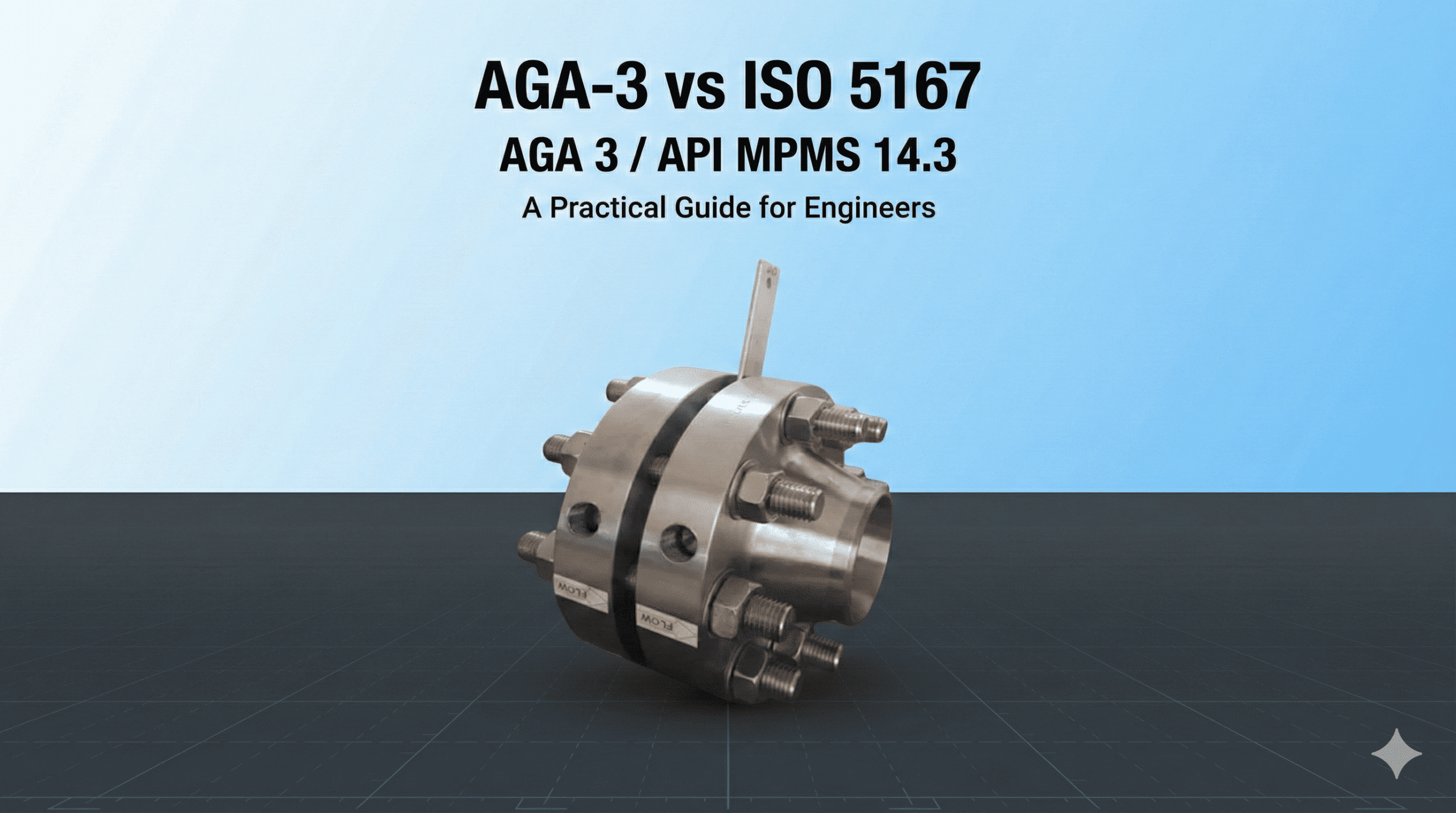
Introduction
If you work with orifice flow meters, you’ve likely encountered two major standards:
- API MPMS 14.3/AGA-3
- ISO 5167
They are describe how to measure flow using differential pressure devices.
Both look technically similar.
Both are widely accepted.
But here’s the important question:
What is the real, practical difference between AGA-3 and ISO 5167 for engineers in the field?
This article explains the difference in simple, practical terms — not theory.
First, What Are These Standards?
AGA-3 (API MPMS 14.3)
AGA Report No. 3, published by the American Gas Association and adopted as API MPMS Chapter 14.3, is primarily focused on:
- Natural gas measurement
- Custody transfer
- Energy accounting
- High-accuracy fiscal measurement
It is heavily used in:
- Gas transmission
- LNG terminals
- Pipeline custody transfer stations
ISO 5167
ISO 5167 is an international standard covering:
- Orifice plates
- Venturi tubes
- Nozzles
It is widely used in:
- Process plants
- Power plants
- General industrial flow measurement
It is more global in application, especially outside North America.
Are the Equations Different?
Yes — but not dramatically.
AGA-3 uses the Reader-Harris/Gallagher equation for discharge coefficient.
ISO 5167 also uses a very similar empirical approach.
In practice:
- Both use discharge coefficient (Cd)
- Both use expansion factor
- Both rely on Reynolds number
- Both assume fully developed flow
The mathematical backbone is similar.
The difference is not in basic physics.
The difference is in application philosophy.
Key Practical Differences for Engineers
Let’s break this down in real-world terms.
1️⃣ Focus of Application
AGA-3/API MPMS 14.3
- Designed specifically for natural gas custody transfer
- Strong emphasis on traceability and audit defensibility
- Linked closely with gas composition and energy calculation
ISO 5167
- Broader industrial application
- Covers multiple DP devices
- Often used in process flow measurement
👉 Practical takeaway:
If you are working in gas custody transfer in North America, AGA-3 dominates.
If you are working in global industrial plants, ISO 5167 is more common.
2️⃣ Installation Requirements
Both standards define:
- Upstream straight length
- Downstream straight length
- Pressure tap locations
- Beta ratio limits
- Reynolds number limits
However, AGA-3 is generally perceived as:
- More conservative for custody transfer
- More explicit about compliance validation
- More structured around audit scenarios
ISO 5167 provides:
- Installation tables
- Flow conditioner guidance
- Broader device coverage
👉 In real projects, both require similar straight length discipline.
3️⃣ Uncertainty & Custody Transfer Mindset
This is where practical difference becomes visible.
AGA-3 is deeply integrated with:
- Gas composition standards
- Supercompressibility calculations
- Energy billing frameworks
It is built around:
Financial defensibility.
ISO 5167 is more measurement-focused than billing-focused.
👉 For fiscal metering, AGA-3 is typically preferred.
4️⃣ Documentation & Implementation
AGA-3 is divided into multiple parts:
- Part 1 – General equations
- Part 2 – Installation
- Part 3 – Gas properties
- Part 4 – Implementation
This structured approach makes it very implementation-driven.
ISO 5167 separates devices into parts:
- Part 1 – General
- Part 2 – Orifice plates
- Part 3 – Nozzles
- Part 4 – Venturi
It focuses more on device geometry and installation.
👉 Engineers implementing flow computers often find AGA-3 more explicit in computational logic.
5️⃣ Flow Conditioners & Disturbance Sensitivity
Both standards address flow disturbance and straight length.
However, in custody transfer applications, operators often:
- Apply worst-case logic strictly
- Avoid engineering assumptions
- Require documented compliance
In many process plants using ISO 5167:
- Engineering judgment is more common
- Space constraints influence decisions
The standards themselves are strict —
the difference is often in how organizations apply them.
6️⃣ Global vs Regional Preference
- North America → AGA-3 dominant
- Europe / Asia → ISO 5167 more common
- International EPC projects → Often ISO 5167
- Gas transmission companies → Mostly AGA-3
This is more about industry ecosystem than technical conflict.
Are They Interchangeable?
In many practical cases, yes — but with caution.
You cannot mix:
- Installation rules from one
- Equations from another
- Uncertainty assumptions loosely
If you declare compliance, it must be fully aligned with one standard.
Hybrid implementation increases audit risk.
So Which One Should You Use?
It depends on:
- Is it custody transfer?
- What does the client specification require?
- What country is the project in?
- What does the regulatory body mandate?
In reality:
- Process engineers often work with ISO 5167
- Measurement engineers in gas transmission often work with AGA-3
Final Summary (Simple Comparison)
| Aspect | AGA-3 | ISO 5167 |
|---|---|---|
| Primary Focus | Natural gas custody transfer | Industrial DP measurement |
| Geography | Strong in North America | Global |
| Structure | Multi-part implementation | Device-based parts |
| Custody mindset | Very strong | Moderate |
| Installation discipline | Strict | Strict |
In simple words:
AGA-3 is measurement for money.
ISO 5167 is measurement for industry.
API MPMS 14.3/AGA3 and ISO 5167 are technically sound.
Both require correct installation.
Both fail if straight length is ignored.
Closing Thought
Engineers often debate AGA-3 vs ISO 5167 as if they are competitors.
They are not.
They are different tools built for slightly different ecosystems.
What matters most is not which standard you choose.
What matters is whether you actually comply with it.
if you want to write an article on the website, please contact us by this mail id: contact@worldofinstrumentation.com
If you like this article, and if you want to know about hookup drawing. Check out my previous article.
And you can also follow our LinkedIn group which is specially made for sharing information related to Industrial Automation and Instrumentation.


